Big spiders are common in Barrie homes and on Lake Simcoe waterfront properties — especially from late spring through fall. The species you encounter, the reason they are there, and the right way to manage them differ significantly between a lakefront dock and a residential property a few kilometres inland. This guide covers what species to expect in Barrie and around Lake Simcoe, why waterfront properties see more spider activity, and what an effective spider control program actually involves. It is for homeowners, cottage owners, and property managers looking for practical spider control solutions for persistent spider problems.
Key Takeaways
- The most common big spiders on Lake Simcoe docks and boathouses are dock spiders (fishing spiders) in the genus Dolomedes — primarily the six-spotted fishing spider (Dolomedes triton) and the striped fishing spider (Dolomedes scriptus).
- Waterfront spider activity is driven by the insect populations Lake Simcoe and Kempenfelt Bay produce — midges, mosquitoes, and lake flies give spiders an abundant food source close to the water.
- Spiders are not classified as insects and require different control methods than typical insect treatment.
- Residential spider activity in Barrie increases from spring through fall, with peak pressure in late summer.
- A professional spider control program combines inspection, web and egg sac removal, habitat modification, targeted treatment, and monitoring — not a single spray application.
Why Barrie and Lake Simcoe Properties See More Spider Activity
Lake Simcoe and Kempenfelt Bay produce substantial swarms of midges, mosquitoes, and lake flies throughout the warmer months. For spiders, this represents a consistent and abundant food supply concentrated along the shoreline. Spider activity is closely tied to the availability of insect prey, and waterfront properties in Barrie sit in a zone of unusually high insect density.
This is why a single contact treatment applied to a dock in June rarely holds through August. The underlying conditions — shoreline humidity, vegetation, dock lighting that attracts insects at night — continue generating the insect population that draws spiders back. Homes near the water consistently experience higher spider activity than inland properties, and that pressure continues as long as the insect food source is there.
Controlling spiders on these properties means addressing the ecosystem supporting them, not just the spiders currently visible.
Dock Spiders: What You’re Actually Dealing With
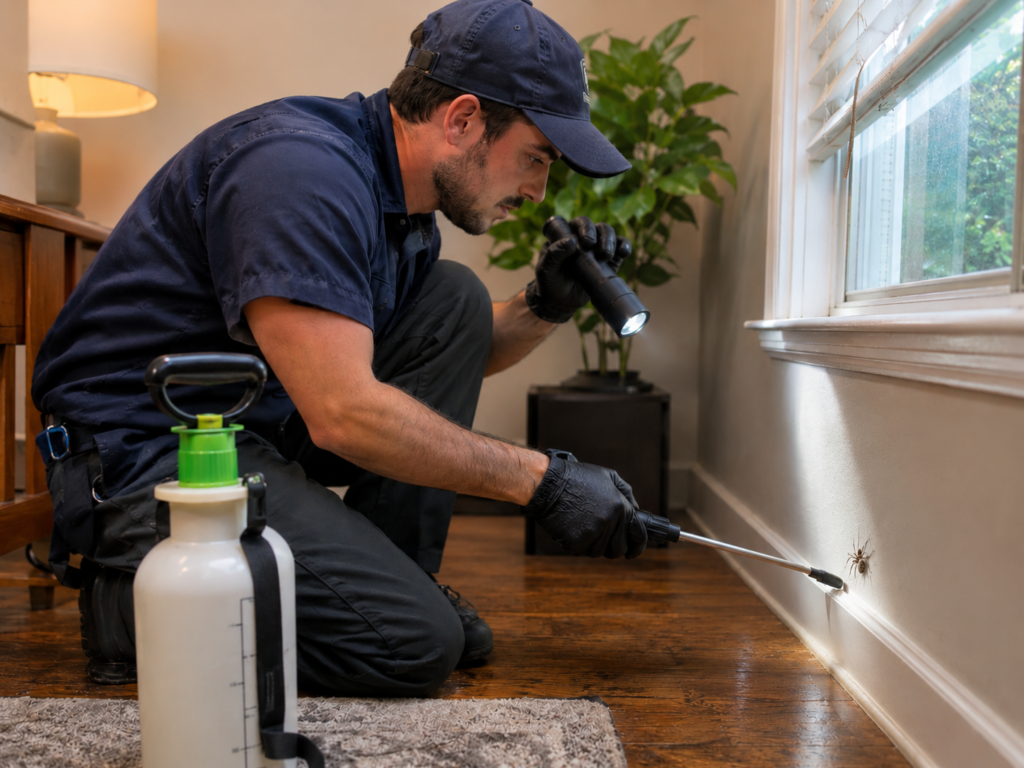
The big spiders found on docks, piers, boathouses, and waterfront decks around Lake Simcoe are almost always dock spiders — fishing spiders in the genus Dolomedes. The two species most common on and near the water in this region are the six-spotted fishing spider (Dolomedes triton) and the striped fishing spider (Dolomedes scriptus).
These are notably big spiders — females typically reach a leg span of 50 to 60 mm. They hunt actively rather than building webs and can move across water surfaces to capture aquatic prey. They are not aggressive and do not typically bite unless handled, but their size makes them alarming when encountered in a boathouse or under dock boards.
Dock spiders are native Ontario wildlife and are not harmful to structures. On docks and boathouses, spider control focuses on removing harborage — debris under dock boards, crevices in older structures, and stored equipment.
Spiders Inside Barrie Homes: Entry Points and Common Pests
Inside Barrie homes, the common pests are more varied. House spiders, cellar spiders, wolf spiders, and to a lesser extent the larger Dolomedes species that wander indoors from lakefront properties all show up in service calls. Spiders prefer quiet, dark spaces for shelter — crawl spaces, wall voids, basements, storage areas, and undisturbed corners are all common harborage sites.
Spiders enter homes through cracks in foundations, gaps around doors and windows, unsealed utility penetrations, and damaged door sweeps. The insects they prey on often enter through the same gaps, so a home with general pest pressure — ants, flies, or other common pests — will also tend to have persistent spider activity.
Residential spider activity increases from spring through fall. Fall is a particular pressure point: as temperatures drop, spiders — including mature males searching for mates — seek shelter indoors, and visible activity in living areas typically increases through September and October.
What an Effective Spider Control Program Looks Like
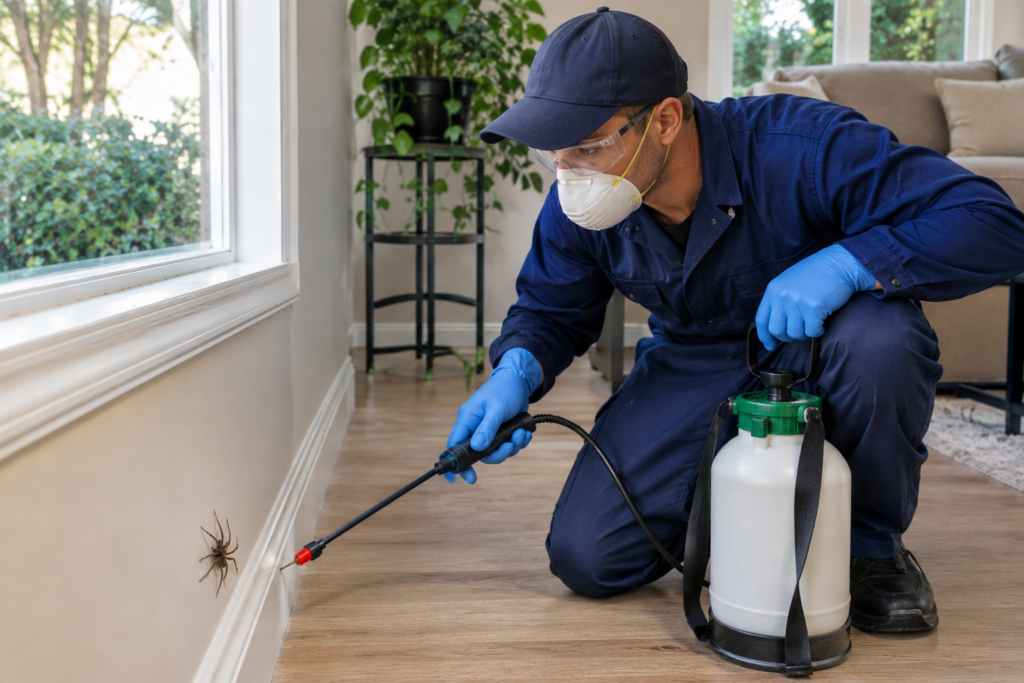
A professional spider control program is not a single spray visit. Because spiders are not insects, the treatment approach differs. Prevention and physical control are the primary spider management strategies, with chemical treatment as a secondary tool.
An effective program includes:
- Inspection: identifying active areas, entry points, harborage sites, and the insect prey supporting spider populations
- Web and egg sac removal: removing webs and egg sacs from eaves, corners, door frames, and exterior walls — this removes active harborage and next-season populations
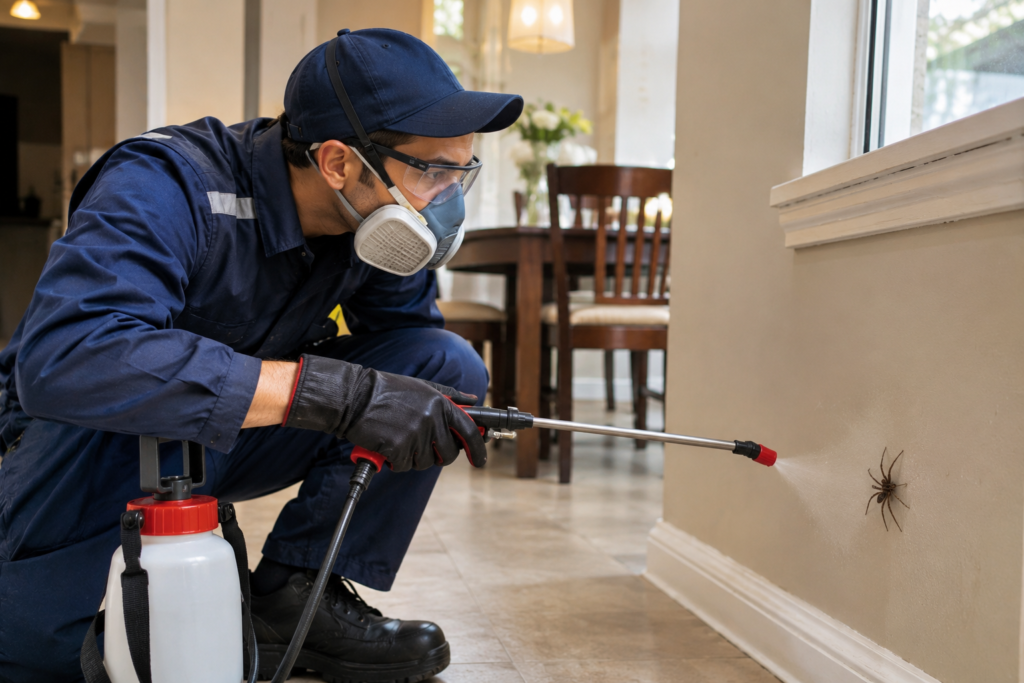
- Targeted treatment: liquid treatments applied around entry points and active areas; dust treatments for wall voids, crawl spaces, and other hard-to-reach areas
- Habitat modification: sealing cracks and gaps, removing clutter from crawl spaces and storage areas, maintaining clearance between vegetation and exterior walls
- Monitoring: sticky traps along walls to track spider activity and assess treatment effectiveness
Keeping Your Barrie Home Spider Free
Between professional pest control services, several measures reduce the conditions that attract spiders indoors:
- Seal gaps around windows, doors, and utility entries using caulking and weatherstripping
- Install door sweeps on exterior doors
- Replace exterior white bulbs with yellow bulbs, which attract fewer insects near entry points
- Regularly vacuum corners, baseboards, and undisturbed areas to remove webs, egg sacs, and harborage
- Reduce clutter in crawl spaces, basements, and storage areas
- Keep vegetation trimmed away from exterior walls
On waterfront properties, switching exterior lighting to yellow-wavelength bulbs reduces the insect density drawing spiders toward the structure at night. These measures are most effective combined with professional treatment, particularly on properties with high insect pressure.
Frequently Asked Questions
What spider species are most common in Barrie homes and on Lake Simcoe docks?
On Lake Simcoe docks and waterfront structures, the most common big spiders are dock spiders in the genus Dolomedes — primarily the six-spotted fishing spider (Dolomedes triton) and the striped fishing spider (Dolomedes scriptus). Inside Barrie homes, common spider species include house spiders, cellar spiders, and wolf spiders. An effective spider control program starts with correct species identification.
What does professional spider treatment involve for a Barrie property?
A professional spider control program includes a site inspection, web and egg sac removal, targeted liquid or dust treatments depending on location, and habitat modification to reduce harborage and entry points. For waterfront properties near Lake Simcoe, follow-up monitoring with sticky traps confirms whether conditions have changed and whether further work is needed.
What pest control services are recommended to keep a home spider free?
A spider control program works best when it combines exclusion, habitat management, regular web and egg sac removal, and targeted treatment of active areas. Professional pest control services provide the inspection, treatment options, and monitoring that DIY approaches miss — particularly dust treatments for wall voids and crawl spaces where spiders harbour but are not easily reached.
When should I contact professional pest control for spider activity in my home?
Contact a professional when spider activity persists despite cleaning and exclusion measures, when egg sacs are visible in multiple locations, when spiders appear repeatedly in living areas, or when the property is a waterfront location with high insect pressure. A quality service will assess the full picture — not only the spiders currently visible but the conditions enabling them.
Spider Control in Barrie: Book an Inspection
If your Barrie home or Lake Simcoe waterfront property has a persistent spider problem, Top Choice Pest Control provides spider control inspections and treatment across Barrie and surrounding Ontario communities.
Call (416) 904-5351 or visit Top Choice Pest Control for a free estimate.