Where you find ants in your home is one of the fastest ways to narrow down the species. Kitchen trails usually point to pavement ants, odorous house ants, or pharaoh ants; ants near window frames or hollow-sounding wood point to carpenter ants; and small reddish ants in garden beds or patio areas point to European fire ants. This guide works through each location so you can identify what you are dealing with and understand what the right response is. For a full breakdown of the five ant species most commonly found in Ontario homes, see types of ants in Ontario.
Key Takeaways
- Where you find ants narrows the species quickly: kitchen trails are usually pavement or odorous house ants; ants near damp wood or window frames are almost always carpenter ants.
- Pharaoh ants are about 2 mm long and yellowish-brown — applying repellent spray to them causes colonies to split into multiple satellite nests, which spreads the infestation.
- Carpenter ants do not eat wood; they tunnel through it and leave coarse frass — a mix of wood shavings and insect parts — near tunnel openings.
- Flying ants indoors in winter indicate an established nest inside the structure, not a seasonal outdoor swarm.
- Odorous house ants release a distinct coconut-like odour when crushed — the simplest identification method without a magnifying glass.
How to Use This Guide
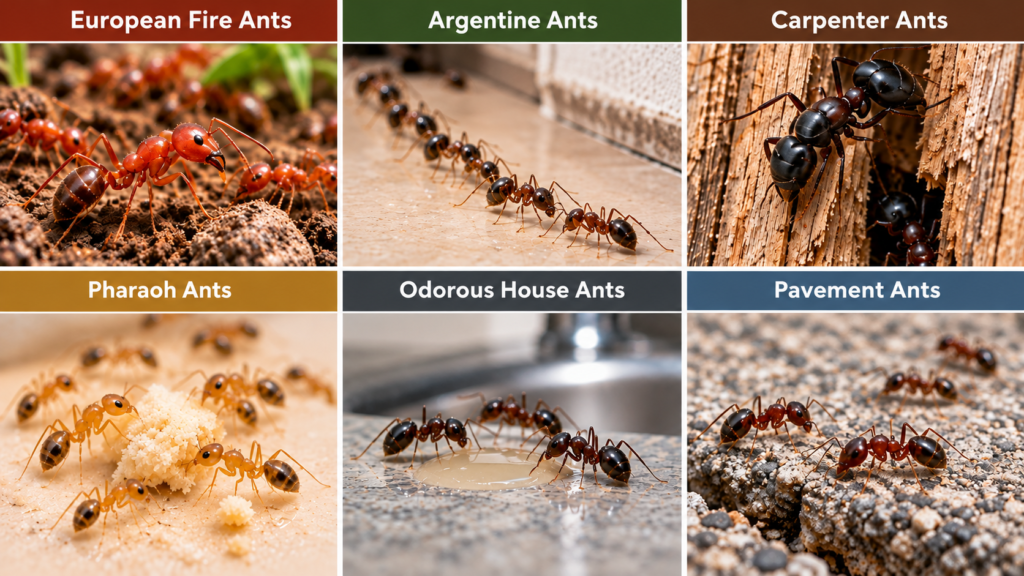
Start with where you found the ants. Each section below describes which species is most likely for that location, what they look like, and what the finding means for treatment.
If the ants are winged, skip to the flying ants section first — winged reproductives require a different read than workers.
Ants in the Kitchen
Kitchen activity almost always traces to one of three ant species. All three are drawn to food sources; the species differs by size, colour, and the type of food they prefer.
Pavement Ants
Pavement ants are 2.5 to 4 mm long, dark brown to black, with two small spines on the thorax visible under a hand lens and fine parallel lines etched on the head.
They nest in soil beneath driveways, patio stones, and foundations and enter homes through tiny cracks in cold weather when outdoor food sources disappear. Ant trails along kitchen baseboards and under appliances are the most common indoor sign.
What to Look For
A steady trail of small, uniformly dark ants running along a baseboard or under the fridge toward a food source.
They forage for both sugary foods and greasy foods. Cleaning food spills and sealing containers disrupts foraging but does not address the outdoor colony.
Odorous House Ants
Odorous house ants are approximately 3 mm long and dark brown to black — similar in size to a small pavement ant but with no spines on the thorax.
The identification shortcut: crush one and smell it. Odorous house ants release a distinct coconut-like odour on contact. No other common Ontario ant species replicates this.
Why They Are Hard to Eliminate
Odorous house ants establish satellite nests inside wall voids and cabinet spaces while maintaining a parent colony outdoors. Removing the food source reduces visible foraging but may not eliminate the indoor nest.
Pharaoh Ants
Pharaoh ants are approximately 2 mm long and yellowish-brown to light amber — noticeably smaller and paler than pavement ants.
They nest in warm, hidden indoor locations: inside wall voids, under flooring, and behind appliances. Pharaoh ants forage for human food and pet food and have been documented carrying pathogens including Salmonella.
Do Not Spray Pharaoh Ants
Applying repellent insecticide to a pharaoh ant infestation causes the colony to split. Queens separate and establish new satellite colonies in different areas of the structure, spreading the problem further.
Baiting is the only reliable treatment for this species and must be handled by a trained technician.
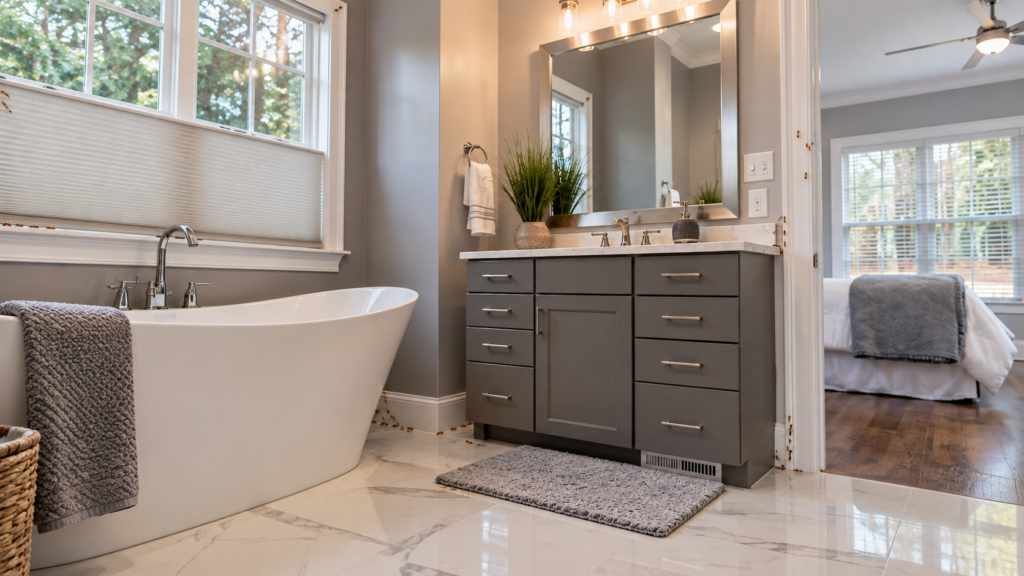
Ants in the Bathroom
Ants in bathrooms are most often following moisture rather than food.
Pavement Ants in Bathrooms
Pavement ants enter bathrooms through gaps around pipes and plumbing penetrations. Trails along the wall near a toilet base or under a vanity cabinet typically indicate an entry point connected to the outside.
Sealing the penetration and addressing the exterior colony is the correct response. Killing the visible ants does not stop reinfestation if the gap remains open.
Pharaoh Ants in Bathrooms
Pharaoh ants nest near warm, humid environments and are frequently found near bathroom plumbing in heated buildings.
Finding pharaoh ants in a bathroom — particularly in an apartment or multi-unit building — warrants a professional assessment before any product is applied.
Ants Near Wood or Window Frames
Ants appearing along window frames, baseboards near exterior walls, or near any area with a moisture history are most likely carpenter ants.
Carpenter Ants
Carpenter ant workers range from 6 to 13 mm in length. Black carpenter ants — solid black with a rounded thorax — are the most common form in Ontario. Red carpenter ants have a reddish-brown upper body segment.
Carpenter ants are the largest ant species likely to appear indoors in Ontario and are noticeably larger than pavement ants or odorous house ants.
What Carpenter Ant Frass Looks Like
Carpenter ants do not eat wood; they tunnel through it to create nesting galleries. They push excavated material out through small openings, leaving coarse frass — a mix of wood shavings, sand-like particles, and insect parts — in small piles near the tunnel exit.
Frass near a baseboard, on a window sill, or under a door frame is the most reliable indicator of an active carpenter ant nest in the surrounding structure.
Moisture Is Almost Always Involved
Carpenter ants prefer decaying or moisture-damaged wood. Finding frass near a window frame usually means there is a moisture problem behind the frame — a failing seal, a roof penetration, or a plumbing leak — that the ants are exploiting as nesting material.
Treating the ants without correcting the moisture source leads to reinfestation.
For how carpenter ant damage differs from termite damage, see carpenter ants vs termites.
Red Carpenter Ants
Red carpenter ants are the same species as black carpenter ants at the worker level, with a reddish-brown colouration on the thorax segment. They are occasionally reported as a separate species by homeowners but are part of the same colony structure.
Flying Ants Indoors
What Flying Ants Mean
Flying ants — winged reproductives — appear when a colony is large enough to produce new queens and males.
Finding winged ants indoors during warm weather may indicate a nearby outdoor colony whose swarm entered through a gap. Finding them indoors during cold winter months is a different situation: it almost certainly means there is an established nest inside the structure that has reached the reproductive stage.
Carpenter Ants or Pavement Ants?
Winged carpenter ants are noticeably larger — up to 25 mm for a queen — with unequal front and hind wings. Winged pavement ants are much smaller.
Winged ant swarmers have a narrow waist and elbowed antennae. Termite swarmers have a broad waist, straight antennae, and equal-length wings. A pile of equal-length wings near a door frame is a termite sign; unequal wings are an ant sign.
What About Argentine Ants and Fire Ants?
Argentine ants are not an established pest species in Ontario and are not typically encountered in residential settings here.
European fire ants (Myrmica rubra) are 4 to 5 mm long and reddish-brown. They nest in soil in gardens, lawns, and under patio stones and are aggressive near disturbed nests. They do not typically nest indoors but are occasionally found foraging inside near ground-level entry points.
When Ant Identification Means You Need a Pro
Pharaoh Ants
Any confirmed pharaoh ant activity indoors — recognised by the small size, yellowish-brown colour, and presence inside heated spaces year-round — requires professional baiting. DIY repellent sprays are counterproductive for this species.
Carpenter Ants
Coarse frass near structural wood, hollow-sounding wood near a moisture source, or winged carpenter ants emerging indoors in winter all warrant a professional inspection. Carpenter ant damage builds over seasons; early treatment reduces repair costs.
European Fire Ants
A nest near a frequently used outdoor area — a children’s play space, a garden bed along a walkway, or a patio — should be treated professionally. European fire ants sting and are aggressive when nests are disturbed.
For ant control in Barrie and across Ontario, Top Choice Pest Control can confirm the species and apply the correct treatment approach.

Frequently Asked Questions
How do I identify what type of ant is in my house?
Start with location, size, and colour. Kitchen trails of small dark ants are usually pavement ants or odorous house ants (crush one — if it smells like coconut, it is an odorous house ant). Yellowish-brown ants near heated spaces are pharaoh ants. Large dark ants near wood or window frames are carpenter ants. Size, colour, and location together narrow the species in most cases.
What are the most common ants found in Ontario homes?
The most common ant species in Ontario homes are carpenter ants, pavement ants, pharaoh ants, and odorous house ants. European fire ants are frequently encountered outdoors in gardens and lawns. Each species differs in size, colour, nesting behaviour, and the appropriate control method.
When should I call an ant exterminator?
Call a professional for pharaoh ant activity (DIY sprays split the colony), carpenter ants near structural wood (damage progresses each season), and European fire ants near outdoor living areas. Pavement ant and odorous house ant problems that continue after sealing entry points and removing food sources also benefit from professional assessment.
What does a carpenter ant infestation look like?
The clearest sign is coarse frass — a mix of wood shavings and insect parts — in small piles near baseboards, window sills, or door frames. Hollow-sounding wood when tapped and large dark ants appearing indoors, particularly near damp areas or at night, indicate an active nest. Winged carpenter ants indoors in winter confirm a nest inside the structure.
Get Ant Control in Barrie and Across Ontario
If you have found ants inside your home and need the species confirmed and treated, contact Top Choice Pest Control. Book through ant control in Barrie or call (416) 904-5351.
Explore the full range of solutions at Top Choice Pest Control services.