In Ontario homes, mice are the more common intruder and easier to address with targeted trapping. Rats are larger, more cautious, cause greater structural damage, and almost always require a licensed pest control company. Top Choice Pest Control helps Barrie homeowners identify which rodent they are dealing with and choose the right treatment before the infestation spreads.
Key Takeaways
- Adult house mice weigh 12–30 grams and can squeeze through holes as small as 6mm; Norway rats weigh 200–400 grams and need openings roughly the size of a quarter (about 25mm).
- Mouse droppings are 3–6mm, dark, and shaped like rice grains; rat droppings are 12–20mm, capsule-shaped, and resemble large dark beans or pellets.
- Rats cause significantly more structural damage than mice—they gnaw through wood, plastic, and light metal, and burrow near foundations.
- Both rats and mice reproduce rapidly and can produce multiple litters per year, making early intervention essential.
- In Barrie, cold weather drives both species indoors in fall, making September through November the peak period for new rodent infestations.
The Short Answer
House mice are the most frequent rodent problem in Ontario homes. If droppings are small (rice-sized), gnaw marks are on low surfaces, and signs appear inside walls and kitchen areas, you are dealing with a mouse infestation. The condition that flips the answer: if droppings are large and capsule-shaped, burrows appear near the foundation, or damage is structural, it is a rat infestation requiring a different approach.
Side-by-Side Comparison
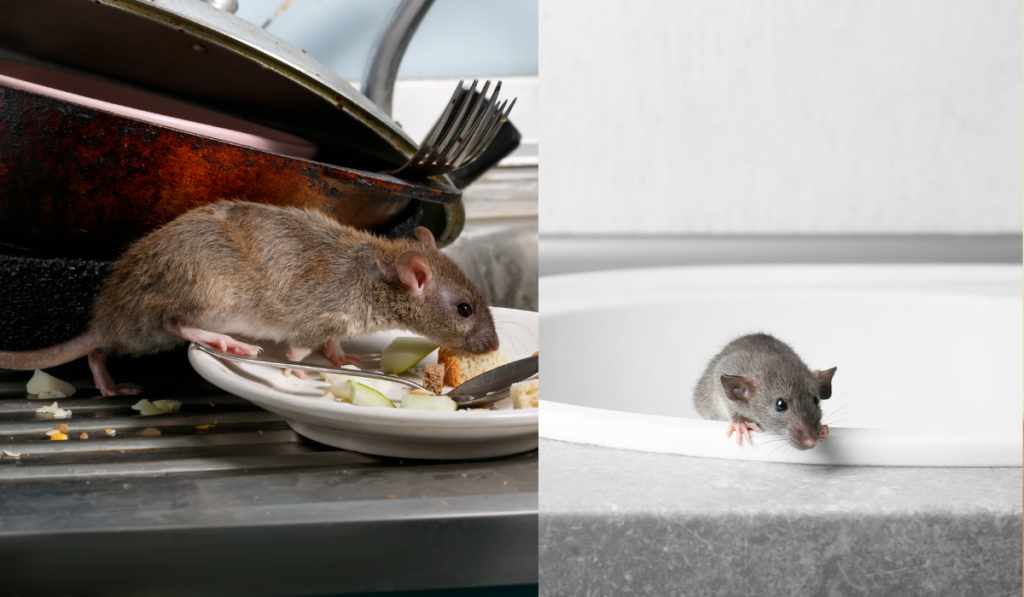
The table below covers the key identification and treatment differences between rats and mice in an Ontario home.
Comparison Table
| Attribute | House mouse | Norway rat |
|---|---|---|
| Size | 12–30g; up to 20cm including tail | 200–400g; up to 45cm including tail |
| Droppings | 3–6mm, dark, rice-shaped | 12–20mm, capsule-shaped, blunt ends |
| Entry point size | 6mm (size of a dime) | ~25mm (size of a quarter) |
| Nesting site | Wall voids, behind appliances, near food sources | Burrows near foundations, crawl spaces, under wood piles |
| Water needs | Gets moisture from food; no daily water source required | Requires a dedicated daily water source |
| Foraging range | 3–9 metres from nest | 30–50 metres from shelter |
| Caution around new objects | Low—explores quickly | High—may avoid snap traps for days |
| Primary disease risk | Hantavirus, Salmonella | Leptospirosis, Rat-bite fever, Salmonella |
Cost
Professional rodent control pricing in Ontario varies by species, property size, and severity. For reference, other pest treatments differ considerably in cost—the resource on how much bed bug treatment costs in Ontario illustrates how professional pest control pricing scales with infestation severity, which applies equally to rodent work.
Option A: Mice Control
DIY snap traps cost $5–$15 each and are effective for light mouse infestations when placed correctly at 90-degree angles to walls where mice travel. Professional mice control in Barrie typically costs $150–$300 for an initial visit covering inspection, trapping, and entry point identification.
The Caveat Most People Miss
Mice get most of their required moisture from their food, so removing food and water sources alone does not reliably drive them out—physical exclusion and trapping are both required.
Option B: Rats Control
Rats are more neophobic than mice and often avoid new snap traps for days. DIY treatment success rates for rat infestations are lower. Professional treatment typically runs $250–$500 or more depending on the extent of burrowing and the number of entry points requiring exclusion.
Time and Effort
A mouse infestation caught early—before a colony is established—can often be resolved in one to two weeks with consistent trapping and exclusion. A rat infestation typically requires a longer timeline: rats travel farther, burrow more extensively, and require a sustained baiting or trapping programme before activity stops. Rats and mice both require follow-up inspections to confirm elimination.
Outcome and Risk
Both species contaminate food and surfaces with droppings, urine, and hair, and both are associated with disease transmission to humans. Rats carry a broader and more severe pathogen profile—including Leptospirosis and Rat-bite fever—while mice are more commonly associated with Hantavirus. Both can trigger asthma and allergic reactions. Rats also pose a greater fire risk from gnawing through electrical wiring and greater structural risk from burrowing near foundations.
When Mice Control Is the Right Call
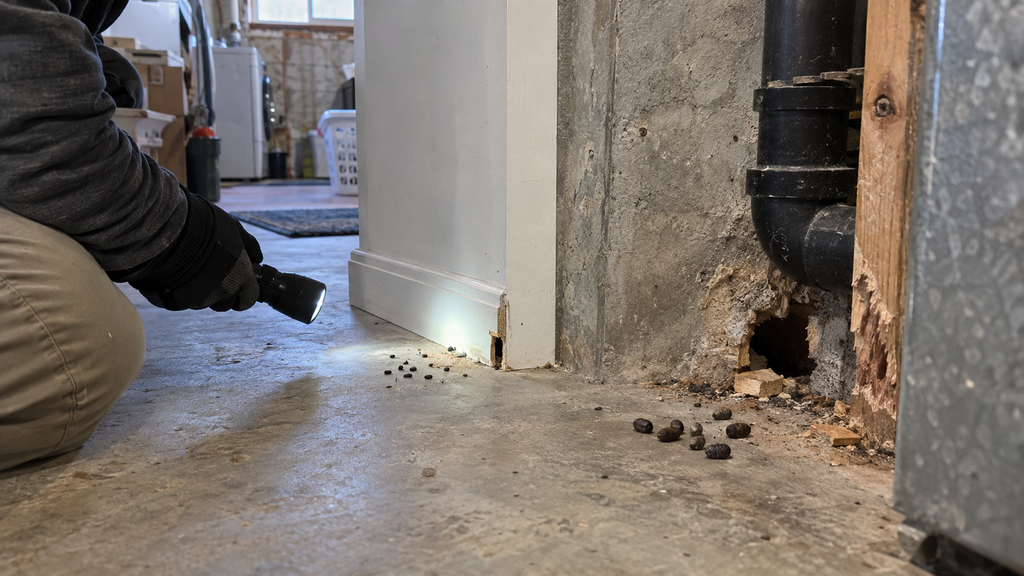
Droppings are small and rice-shaped. Rice-grain-sized droppings along baseboards, behind appliances, or in cupboards indicate house mice rather than rats. An article on rats vs mice — how to tell which one you have provides a visual comparison if identification is uncertain.
Gnaw marks are on food packaging or low surfaces only. Mice gnaw primarily to access food. Gnaw marks on cereal boxes, pet food bags, and wood near the base of cabinets point to mice rather than the structural gnawing associated with rats.
Activity is concentrated near the kitchen. Mice typically stay within 3–9 metres of their nest when food and water sources are close. If rodent activity is clustered around the kitchen or pantry, you are almost certainly dealing with a mouse infestation rather than rats, which forage over a much wider range.
When Rat Control Is the Right Call
Droppings are large and capsule-shaped. Capsule-shaped droppings 12–20mm long with blunt ends confirm rats. A rat infestation tends to be more localized around a specific food source, but the physical signs are unmistakably larger. Contact a licensed rats mice pest control Barrie service rather than attempting DIY treatment.
Burrows appear near the foundation or under wood piles. Norway rats burrow near building foundations, under garden sheds, and beside compost bins. A burrow entrance 5–7cm in diameter with fresh soil at the entrance indicates active Norway rat activity.
Structural damage or gnawing on cables is present. Rats gnaw through materials mice typically cannot—floor joists, plastic pipes, and electrical cables. If gnaw marks are large, deep, or appear on structural materials rather than packaging, rat control is the appropriate response.
What Most People Get Wrong
The most common mistake with rodent infestations is treating the symptom—setting a few traps—without addressing the food source or entry points. Mice and rats can continue entering from outside if gaps remain open, and an established colony can outlast a small number of traps indefinitely. Both species will contaminate food stored in cardboard or thin plastic; switching to glass containers and airtight containers with tight-fitting lids is a necessary part of any rodent control programme. Glue traps are widely sold but not recommended as a primary control method—they capture individual animals while leaving the source colony intact, and they raise welfare concerns that some pest control companies avoid. For clients outside Barrie, the same principles apply whether you are seeking mice control Vaughan or anywhere else across southern Ontario.
What We Recommend for Barrie Homeowners
Top Choice Pest Control recommends starting with a professional inspection to confirm the species—misidentifying a rat infestation as mice leads to undersize trapping programmes that fail. Once the species is confirmed, technicians locate entry points at ground level, recommend exclusion materials (steel wool, fine mesh metal screening, or weather stripping depending on the gap type), and implement a trapping programme scaled to the infestation size. The company’s mice control in Barrie service covers both mice and rat problems, with follow-up visits included to verify that rodent activity has stopped before the file is closed.
Frequently Asked Questions
What is the difference between mice vs rats in Ontario?
House mice are 12–30 grams with small, rice-shaped droppings and stay close to their nest. Norway rats are 200–400 grams with large, capsule-shaped droppings and forage up to 50 metres. Rats burrow near foundations; mice nest in wall voids and near food sources. Both require exclusion of entry points in addition to trapping for effective control.
How do I identify a rat infestation vs a mouse infestation?
Dropping size is the most reliable indicator. Mouse droppings are 3–6mm, dark, and pointed at both ends. Rat droppings are 12–20mm, capsule-shaped, and blunt-ended. Burrows near the foundation confirm rats. Gnaw marks on food packaging at low levels, with small droppings nearby, confirm mice. When uncertain, contact a licensed pest control company for a site inspection before starting treatment.
How do I locate entry points for mice and rats to prevent rodents?
Mice can enter through gaps as small as 6mm; rats need roughly 25mm. To locate entry points, inspect at ground level around foundation corners, where pipes and cables enter walls, around dryer vents, and along door sweeps and weather stripping. Use a torch in low light—daylight visible through gaps confirms an opening. Seal confirmed gaps with steel wool packed tightly and covered with fine mesh metal screening.
Are glue traps effective for rodent infestations?
Glue traps capture individual rodents but do not address the colony. They are not recommended as a primary control method for rat or mouse infestations. Snap traps placed at 90-degree angles to walls along active runways are more effective and provide a faster outcome. For an established rodent infestation, a combination of trapping and exclusion—rather than traps alone—is the only approach that reliably ends the problem.
About Top Choice Pest Control
Top Choice Pest Control serves Barrie and surrounding communities with licensed pest management services covering mice, rats, ants, bed bugs, cockroaches, wasps, and wildlife. The company holds all required Ontario licences and carries liability insurance. All treatments are applied by trained technicians following Health Canada guidelines. Review the full service range through mice control in Barrie on the company website.
Service Area
Top Choice Pest Control operates throughout Barrie, Innisfil, Angus, Orillia, and the broader Simcoe County region. The company also serves clients across the Greater Toronto Area, including Vaughan, North York, and surrounding southern Ontario municipalities.
Next Step
If you have identified signs of a mouse or rat infestation in your Barrie home and want a confirmed species identification and treatment plan, contact Top Choice Pest Control. Book through the mice control in Barrie page.
Explore the full range of solutions at Top Choice Pest Control services.