Wasps, hornets, and bees are distinct stinging insects with different body shapes, nesting habits, and appropriate responses. In Ontario, bald-faced hornets and yellowjackets are the most common removal cases; honey bees and bumble bees should be relocated rather than exterminated. Top Choice Pest Control helps Barrie homeowners confirm which insect they are dealing with so the right action is taken safely. Treating a bee colony as a wasp nest—or vice versa—produces the wrong outcome. This blog will help property owners understand the difference between wasps, hornets, and bees/
Key Takeaways
- Bald-faced hornets grow colonies of 400–700 workers in a single Ontario season, with nests reaching basketball size by late August.
- Honey bees carry a barbed stinger and die after a single use; wasps and hornets have smooth stingers and can sting repeatedly without dying.
- European hornets are the only true hornet species established in Ontario and are the largest social wasp in the province, reaching up to 35mm.
- Cicada killer wasps measure up to 40mm and look alarming but are solitary wasps, rarely sting humans, and do not defend a shared nest.
- Mud daubers and digger wasps are solitary wasps that almost never sting and generally require no pest control treatment.
The Short Answer
Wasps and hornets are colonial stinging pests that defend their nests aggressively; bees are generally docile, defensive rather than aggressive, and are vital pollinators. If the insect has a slim, smooth waist and is constructing a papery or underground nest, it is a wasp or hornet and may need professional removal. If it is round, fuzzy, and collecting flower nectar and pollen from plants, contact a local beekeeper rather than a pest control company. Top Choice Pest Control provides bee and wasp removal in Vaughan and across the Greater Toronto Area for confirmed cases requiring professional attention.
Side-by-Side Comparison
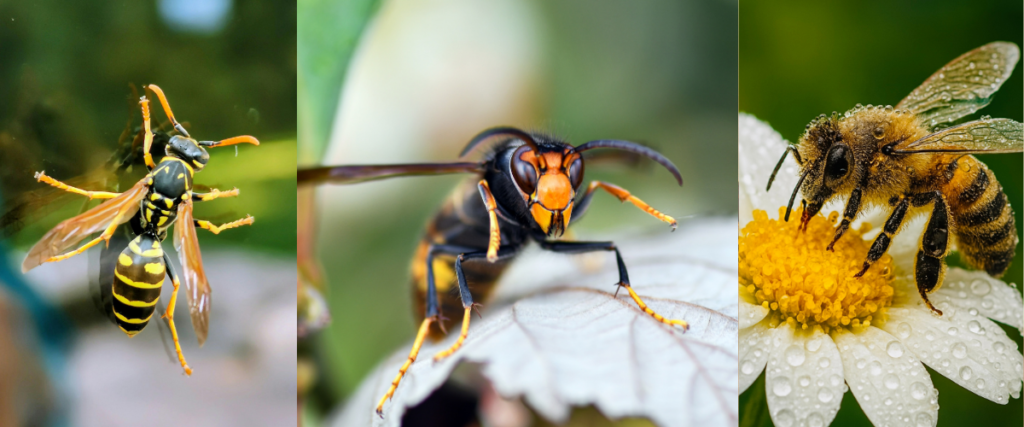
The table below covers the most common stinging insects encountered by Ontario homeowners, organized by species group for quick identification. Use body shape, nest type, and nesting location together—no single characteristic is definitive on its own.
Comparison Table
| Attribute | Yellowjacket / Paper Wasp | Bald-Faced Hornet / European Hornet | Honey Bee / Bumble Bee |
|---|---|---|---|
| Size | 10–20mm | 18–35mm | 12–25mm |
| Body | Slim waist, smooth hairless body, yellow and black stripes or yellow markings | Slim waist, large head; black and white (bald-faced) or brown and yellow bands (European) | Rounded body, fuzzy, golden-brown or black with yellow bands |
| Nest type | Paper nests built from chewed wood fibers and saliva; yellowjackets build nests underground | Teardrop-shaped enclosed aerial nests in trees or sheltered structures; European hornets favour hollow trees | Wax honeycomb in tree cavities or wall voids; bumble bees in ground cavities |
| Nesting location | Underground, wall voids, eaves, tree branches | Trees, shrubs, attics, hollow trees, wall voids | Wall voids, tree cavities, underground burrows |
| Aggression | Moderate to high; yellowjackets highly aggressive late summer | High; attack in numbers with little provocation when feel threatened | Low; sting only when nest is disturbed or directly handled |
| Sting | Smooth stingers; sting multiple times | Smooth stingers; hornet stings are the most painful among stinging insects | Honey bees have barbed stinger, die after one use; bumble bees can sting repeatedly but rarely do |
| Primary diet | Insects, protein, sugary substances near trash cans | Other insects, tree sap | Flower nectar and pollen exclusively |
| Best response | Professional removal for active nests | Professional removal; never disturb a hornet nest | Contact local beekeepers for relocation |
Nesting Habits by Species
Understanding where each insect builds its nest helps confirm the identification before getting close. Yellowjackets build nests underground or in wall voids; worker activity concentrated around a single ground hole in a lawn or foundation crack is the primary sign. Paper wasp nests are open-combed and umbrella-shaped, typically hanging from tree branches, eaves, or door frames. Bald-faced hornet nests are large enclosed paper nests in trees or shrubs—rounded and grey, with a single entry point at the bottom. European hornets nest in hollow trees, attic spaces, and wall voids and are more active at night than other wasp species.
Honey bees establish honeycomb colonies in tree cavities, wall voids, and occasionally in roof spaces; honeybee colonies are perennial and can grow very large over multiple seasons. Bumble bees typically nest underground in abandoned rodent burrows or under dense grass. Carpenter bees tunnel into wood rather than building a communal nest structure—look for round entry holes 10–12mm in diameter in unpainted wood surfaces.
Cost
Wasp and hornet nest removal in Ontario runs approximately $150–$500 depending on species, nest location, and accessibility. A ground-nesting yellowjacket colony or a wall-void nest costs more than an exposed exterior paper wasp nest due to access difficulty. Bee relocation varies; many local beekeepers collect accessible swarms at low or no cost, though an established honey bee colony in a wall void requires extraction and structural repair.
Option A: Wasp and Hornet Removal
An exposed exterior paper wasp nest typically costs $150–$250 for professional removal. A bald-faced hornet nest high in a tree or a yellowjacket colony inside a wall void runs $250–$500 or more depending on the number of entry points and the colony size reached by the time of the call. European hornet nests inside attic or soffit cavities fall at the upper end of this range.
The Caveat Most People Miss
Ground-nesting yellowjackets are consistently underestimated. A colony in soil can hold several thousand workers and cannot be resolved by sealing the entrance—blocking the primary hole forces workers to locate secondary exits, often directly into living areas through internal wall gaps.
Option B: Bee Relocation
Honey bee swarms are the least expensive relocation scenario and can often be collected by a local beekeeper at little or no cost. An established honeycomb colony inside a wall void requires a full extraction, structural opening, and comb removal—costs vary by contractor and the extent of the build-up. Carpenter bee tunnels in structural wood require wood filler and exclusion treatment after the bees vacate in late fall, not a pest control company.
Time and Effort
A wasp or hornet nest treated professionally is typically inactive within 24–48 hours after a single visit, with a follow-up confirming elimination before the file is closed. A bee swarm can be collected in an afternoon. An established honey bee colony in a wall void requires a longer timeline—the extraction itself may take several hours, and structural repairs add additional time. Carpenter bee activity in wood typically peaks in spring and tapers by early summer, with exclusion most effective from September onward.
Outcome and Risk
Wasps and hornets pose genuine physical risk when their nests are disturbed. Bald-faced hornets attack in numbers and can sting repeatedly; hornet stings are considered the most painful among stinging insects and carry a real anaphylaxis risk. Honey bee stings are less painful on average and bee stings occur less frequently because honey bees die after stinging and are therefore selective about when they use it. Both wasp stings and bee stings can cause severe allergic reactions in sensitive individuals; any household member with a known allergy warrants professional treatment rather than a DIY approach.
When Wasp or Hornet Removal Is the Right Call
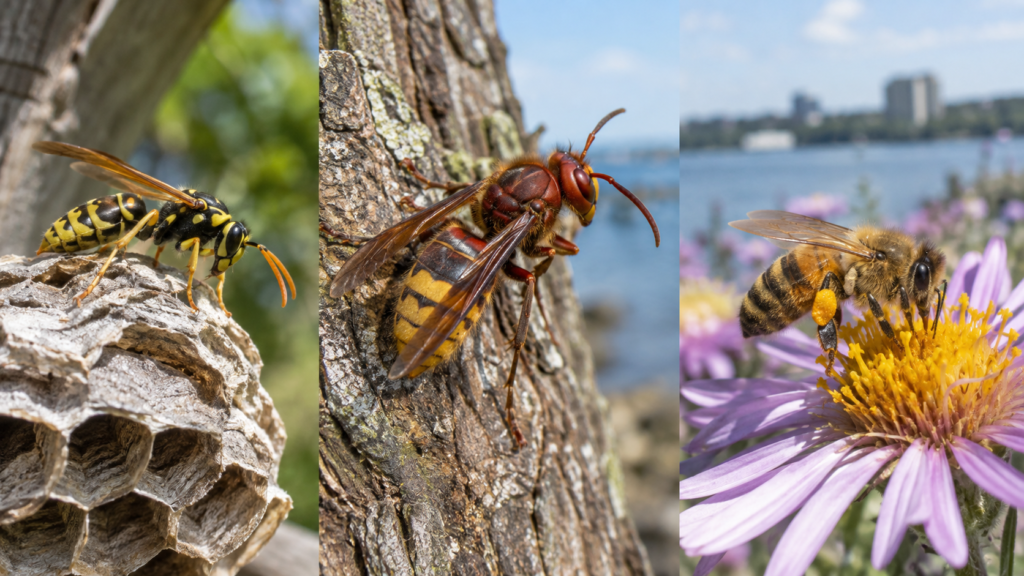
The nest is actively defended. Yellowjackets, paper wasps, bald-faced hornets, and European hornets all defend their nests when disturbed. Approaching within a few metres and observing defensive flight is a clear indicator that professional removal is required. For information on what this process involves in Barrie, see wasp and hornet removal in Barrie safe and effective solutions before attempting anything yourself.
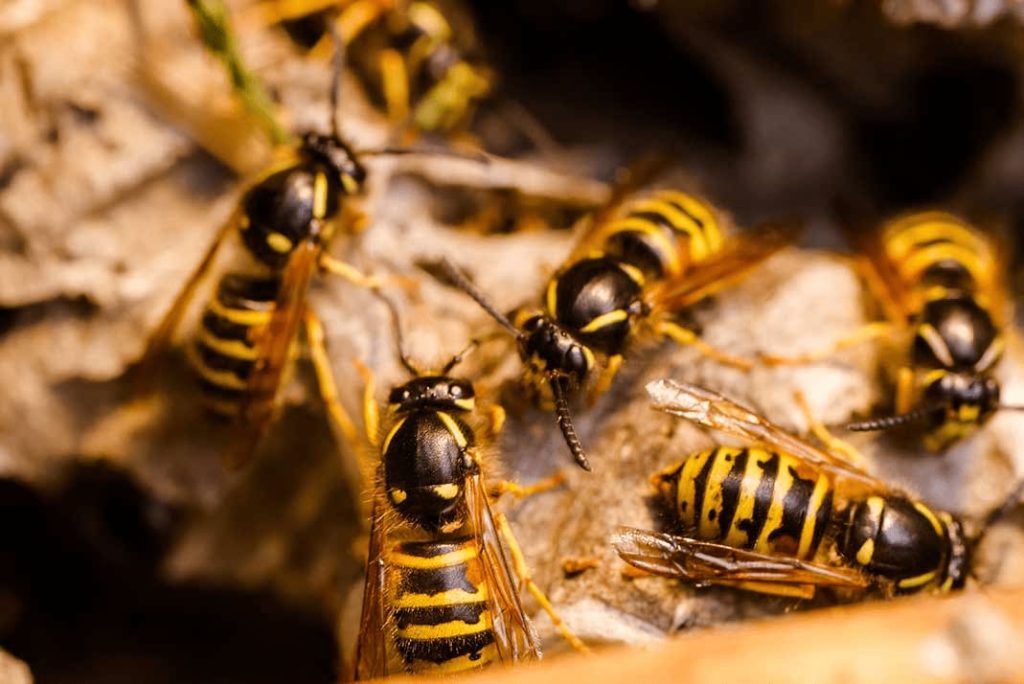
The insects have a slim, smooth waist. Yellow and black stripes with a clearly pinched waist between the thorax and abdomen confirm a wasp or hornet. Unlike bees, wasps have smooth, hairless bodies and do not collect pollen—they move quickly between protein sources, sugary substances, and the nest. Wasps do not have the visible fuzzy body hair that distinguishes bees even from a short distance.
The nest is made of papery material or is underground. Social wasps build nests from chewed wood fibers and saliva, producing the characteristic grey paper nests visible under eaves, on tree branches, or in attic spaces. Yellowjackets build nests underground with no external structure visible above the entrance hole. Neither of these materials is wax, which is the definitive characteristic of a honey bee nest. If the nest has no visible papery material and the insects are round and fuzzy, it is almost certainly a bee colony.
When Bee Relocation Is the Right Call
The insects are round, fuzzy, and visiting flowers. Bees are generally rounder and fuzzier than wasps, with visible pollen sacs on their hind legs or pollen coating their bodies. A fuzzy, slow-moving insect moving systematically between flowering plants is collecting pollen and is a bee. Unlike wasps, bees feed exclusively on flower nectar and pollen and are not drawn to protein waste, meat scraps, or sugary substances in trash cans.
A cluster or swarm has appeared on a branch or structure. Honey bee swarms—a dense hanging mass of bees temporarily resting on a fence post, tree branch, or wall—are a relocation opportunity, not an emergency. A swarm is the colony in transit between nest sites; it has no comb or brood to defend and is the least aggressive state a honey bee colony ever occupies. Most swarms move on within 24–72 hours; contact a local beekeeper immediately. For further detail on telling these insects apart before taking any action, the resource on wasps vs hornets vs bees difference covers appearance and behaviour in detail.
Large bees are boring into wood. Carpenter bees are solitary bees—not social insects—that tunnel into unpainted or weathered wood. They do not form colonies or defend a shared nest. Male carpenter bees hover near the tunnel entrance and appear aggressive but have no stinger at all; females can sting but rarely do unless directly handled. Carpenter bees require wood repair and exclusion after the season, not a pest control treatment.
What Most People Get Wrong
The most common misidentification in Ontario is treating a bald-faced hornet nest as an ordinary wasp nest and underestimating the colony size and aggression level. Bald-faced hornets are technically a species of yellowjacket, not a true hornet—the only true hornet established in Ontario is the European hornet (Vespa crabro). The Asian giant hornet, sometimes called the murder hornet, has been detected in British Columbia but is not established in Ontario. Despite the labeling difference, bald-faced hornets are among the most defensive stinging insects in the province and their nests should never be approached without protective equipment.
A second common mistake is sealing an active wasp nest or hornet nest entrance before or immediately after applying a product. Blocking the primary entry point of an active colony forces workers to locate secondary exits—frequently through wall spaces and into living areas. Wait a minimum of 48 hours after a confirmed treatment before sealing any opening. For a complete walkthrough of safe treatment approaches, see how to safely get rid of wasps and hornets before attempting any nest removal.
Not all wasps are a pest control problem. Solitary wasps—including mud daubers, digger wasps, and cicada killer wasps—are beneficial insects that prey on spiders, caterpillars, and other insects, helping regulate insect populations in Ontario gardens. Mud daubers build mud nests on walls and are non-aggressive; digger wasps and cicada killer wasps nest underground but do not defend a colony and rarely sting. A single large wasp working alone near a soil entrance poses no meaningful risk to people unless it is nesting in a high-traffic area.
Applying repellent sprays to an active hornet nest or yellowjacket colony causes wasps to scatter and locate alternative exits rather than eliminating the colony. Remove food sources, seal garbage containers, and avoid leaving sugary substances outdoors to reduce foraging pressure—but this alone will not eliminate an established nest. Cultivating basil, marigold, or other plants that are reported to repel wasps around outdoor eating areas may reduce foraging activity at the margins but is not a substitute for treating an active nest.
What We Recommend for Barrie Homeowners
Top Choice Pest Control recommends confirming the species before any removal attempt. Misidentifying hornets and wasps—or treating a honey bee colony as a wasp nest—produces the wrong treatment and can make the situation significantly worse. In Barrie and surrounding Simcoe County, bald-faced hornets, yellowjackets, and paper wasps are the most common social wasps requiring professional treatment during the season. European hornets are present in the region but less commonly encountered; they often nest in hollow trees or attic spaces and become active at dusk.
For confirmed wasp or hornet nests, Top Choice technicians locate all access points, including secondary entry points that are frequently missed in DIY attempts, and apply Health Canada–registered treatments at dusk when worker populations are inside the nest and activity is lowest. For bees, the company’s position is relocation first—a swarm or accessible honey bee colony is referred to a local beekeeper before any pesticide treatment is considered.
For professional bee and wasp removal in Vaughan and across southern Ontario, Top Choice carries all required Ontario licences and liability insurance. Barrie-area homeowners dealing with an active nest can also book wasp nest removal Barrie for a local inspection and same-season treatment.
Frequently Asked Questions
What is the difference between wasps vs hornets vs bees?
Wasps have a slim, smooth waist and yellow and black stripes; they can sting repeatedly due to smooth stingers. Hornets are a subgroup of social wasps—larger, with thicker bodies and larger heads, and more aggressive near their nests. Bees are rounder, fuzzier, and collect pollen; honey bees carry a barbed stinger and die after stinging. All three belong to the insect order Hymenoptera.
Are bald-faced hornets and European hornets dangerous in Ontario?
Yes. Bald-faced hornets and European hornets both defend their nests forcefully and can sting multiple times. Hornet stings are the most painful among stinging insects and can cause severe reactions in sensitive individuals. Bald-faced hornets are common across Ontario; European hornets are less common but larger, reaching 35mm. Do not approach an active hornet nest—professional removal is required for both species.
What are cicada killer wasps and digger wasps?
Cicada killer wasps are large solitary wasps—up to 40mm—that nest underground and stock their burrows with paralyzed cicadas as food for their larvae. Digger wasps are a broader category of solitary, ground-nesting wasps. Both species are beneficial insects, predating on other insects and helping regulate local populations. They are not aggressive and rarely sting humans; treatment is not necessary unless they are nesting in a heavily trafficked area.
Are hornets and wasps beneficial insects?
Hornets and wasps are beneficial insects ecologically—they prey on caterpillars, flies, aphids, and other small insects, helping control pest populations in gardens and on crops. However, when nests are near a building or in a high-traffic area, the risk to people and pets outweighs the ecological benefit and professional removal is appropriate. Bees are more directly beneficial as pollinators and should always be relocated rather than exterminated where possible.
About Top Choice Pest Control
Top Choice Pest Control serves Barrie and surrounding communities with licensed pest management covering wasps, hornets, bees, ants, bed bugs, cockroaches, rodents, spiders, and wildlife. The company holds all required Ontario pest control licences, carries full liability insurance, and applies only Health Canada–registered products following Pest Management Regulatory Agency (PMRA) label directions. All treatments are carried out by trained technicians. For bee and wasp removal in Vaughan and across the Greater Toronto Area, the same licensing standards and treatment protocols apply.
Service Area
Top Choice Pest Control operates throughout Barrie, Innisfil, Angus, Orillia, and the broader Simcoe County region. The company also serves clients across the Greater Toronto Area, including Vaughan, North York, and surrounding southern Ontario municipalities. Contact the Barrie office directly for scheduling or a same-season assessment.
Next Step
If you have found an active wasp nest, hornet nest, or bee colony near your Barrie home and want a confirmed identification and treatment plan, contact Top Choice Pest Control. Book through the bee and wasp removal in Vaughan page.
Explore the full range of solutions at Top Choice Pest Control services.