Five ant species account for most homeowner problems in Ontario: carpenter ants, pavement ants, pharaoh ants, odorous house ants, and European fire ants. This guide identifies each species by size, colour, and nesting behaviour, explains which ones damage homes or contaminate food, and helps Ontario homeowners recognise when professional ant control is the right response.
Key Takeaways
- Carpenter ants are the only ant species in Ontario that cause structural damage — they tunnel through wood to create nesting galleries, weakening beams and framing over time.
- Pharaoh ants are the hardest indoor ant to eliminate: applying repellent sprays causes their colonies to split into multiple satellite colonies, spreading the infestation further.
- Pavement ants enter homes through the smallest cracks in cold winter months and are among the most commonly reported indoor ant species across Ontario.
- Odorous house ants release a distinct coconut-like odour when crushed — the fastest way to identify this species indoors without a magnifying glass.
- European fire ants are established in Ontario, are aggressive near disturbed nests, and deliver a painful sting; they should not be confused with red imported fire ants, which are not present in Canada.
Five Ant Species in Ontario
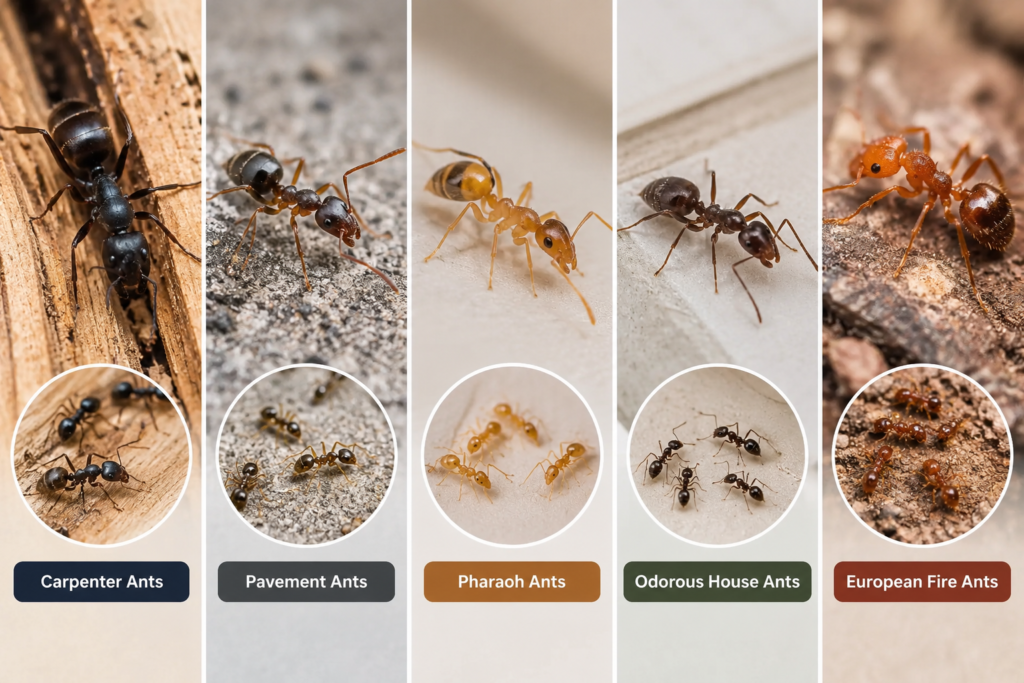
The ant species most likely encountered in Ontario homes differ in size, colour, nesting preference, and the level of risk they present. Identifying the correct species is the first step toward the right control method — the wrong approach can make some infestations significantly worse. For a detailed photo identification guide covering these and other species, see how to identify ants in your house.
Carpenter Ants
Size and Colour
Carpenter ants are the largest ant species commonly found in Ontario homes. Workers range from 6 to 13 mm; queens can reach 25 mm. Black carpenter ants — solid black with a rounded thorax — are the most common form. Red carpenter ants, which have a reddish-brown upper body segment, are also present in Ontario and are occasionally misidentified as a separate species.
Where Carpenter Ants Nest
Carpenter ants prefer decaying or moisture-damaged wood. They excavate smooth galleries along the wood grain to create nesting space, leaving behind a coarse frass that contains wood shavings and dead insects in small piles near tunnel openings. Carpenter ants do not eat wood — they remove it. Indoor satellite nests form near plumbing leaks, damp areas, or damaged wood in wall voids and door frames; the parent colony is typically outdoors in old stumps or decaying trees.
Signs of an Active Infestation
Coarse frass near baseboards or window frames, hollow-sounding wood when tapped, and worker ants foraging indoors during late spring or early summer are the most consistent signs. Winged ants emerging indoors during cold winter months indicate an established indoor nest that has reached the reproductive stage.
When to Call
Frass near structural wood or rustling sounds inside wall voids warrant a professional inspection. Carpenter ant damage worsens with each season until both the moisture source and the colony are addressed. For how this damage differs from termite activity, see carpenter ant vs termite damage. To book treatment, see ant control services.
Pavement Ants
Size and Colour
Pavement ants measure 2.5 to 4 mm and are dark brown to black. They are identified by two small spines on the thorax and fine parallel lines etched on the head and thorax — features visible under a hand lens.
Where Pavement Ants Nest
Pavement ants prefer to nest in soil beneath patio stones, concrete slabs, sidewalks, and driveways. They forage for sugary or greasy foods and enter homes through tiny cracks in foundations and door frames, most noticeably during cold winter months when outdoor food sources disappear. Ant trails along baseboards and window frames are the most common indoor sign.
When to Call
Pavement ants can contaminate food surfaces with microbes carried on their bodies. If colonies are active indoors — not just occasional scouts — rather than limited to the yard, professional ant control services offer the most reliable path to elimination.
Pharaoh Ants
Size and Colour
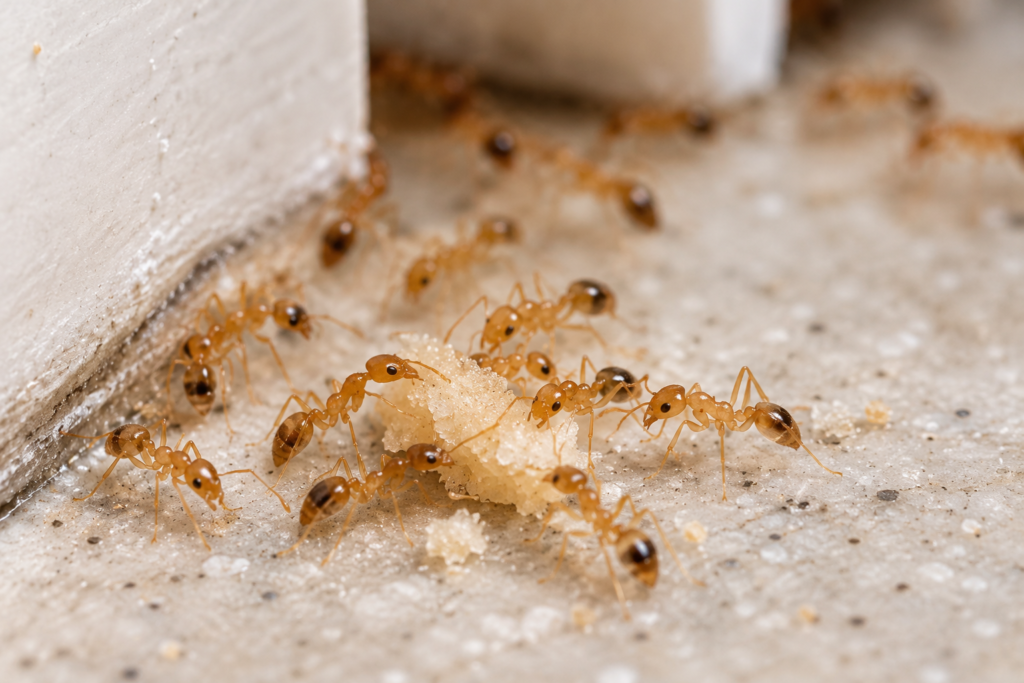
Pharaoh ants are approximately 2 mm long and yellowish-brown to light amber in colour. They are among the smallest ant species found indoors in Ontario and are sometimes confused with odorous house ants despite the clear size and colour difference.
Where Pharaoh Ants Nest
Pharaoh ants nest in warm, inaccessible indoor locations: inside wall voids, behind appliances, under flooring, and within heated buildings. A colony can span multiple satellite colonies with multiple queens and grow very large. Pharaoh ants forage for human food, pet food, and greasy foods and have been documented carrying pathogens including Salmonella.
Why Spraying Makes It Worse
Applying repellent insecticide to a pharaoh ant infestation causes the colony to split. Queens separate and establish new satellite colonies in different parts of the structure, turning a localised problem into a distributed one. Baiting by a trained technician is the only reliable treatment approach for this species.
When to Call
Contact ant control services at the first confirmed sign of pharaoh ants. DIY surface sprays are counterproductive for this species and consistently extend the infestation.
Odorous House Ants
Size and Colour
Odorous house ants are approximately 3 mm long and dark brown to black — a dark ant sometimes mistaken for a small carpenter ant or pavement ant. The identification shortcut: crush one. Odorous house ants release a distinct coconut-like odour immediately on contact, which no other common Ontario ant species replicates.
Where Odorous House Ants Nest
Odorous house ants nest under floors, inside wall voids, and in humid environments near moisture sources indoors. They forage for sugary foods and establish satellite nests inside structures while maintaining a parent colony outdoors. Ant trails leading to kitchen surfaces, pantry areas, or pet food are the most common indoor sign.
When to Call
If sealing entry points and removing food sources does not stop visible ants within a week, the satellite nest inside the structure has not been located. Professional assessment identifies where the colony is active and which entry points are in use. Book through ant control services.
European Fire Ants
Size and Colour
European fire ants (Myrmica rubra) are 4 to 5 mm long and reddish-brown. They are the fire ant species established across Ontario and should not be confused with red imported fire ants (Solenopsis invicta), which are a North American species found in the southeastern United States and are not present in Canada.
Where European Fire Ants Nest
European fire ants nest in soil in gardens, under patio stones, in lawns, and in areas with decaying organic matter. They do not typically nest indoors but forage into structures and are commonly encountered in outdoor living areas. European fire ants are aggressive when their nests are disturbed and deliver a painful sting, which sets them apart from most other ant species found in Ontario.
When to Call
European fire ant stings are a real concern for children, pets, and anyone with an insect venom sensitivity. If a nest is found near a frequently used outdoor area, professional removal through ant control services is the safe response.
Which Ontario Ants Damage Homes
Structural Damage
Carpenter ants are the only species among the five that cause significant structural damage. They excavate galleries through moisture-damaged wood in floor joists, window frames, and wall framing, weakening the structure progressively. The damage accumulates quietly — a colony active inside a home for several seasons can reach the point of costly repairs before the signs become obvious indoors.
Contamination Risk
Pharaoh ants present the highest documented contamination risk. They move freely between waste and food storage areas and carry pathogens on their bodies. Pavement ants and odorous house ants also contaminate food surfaces but at a lower documented risk than pharaoh ants.
What About Argentine Ants and Fire Ants in Ontario
Argentine ants are not established as a resident species in Ontario. They are occasionally intercepted in shipments and may survive briefly in heated indoor environments, but they are not considered part of the province’s ant fauna in residential settings. Red imported fire ants are not found in Ontario; the fire ant relevant to homeowners in this province is the European fire ant, covered above.
When to Call for Ant Control
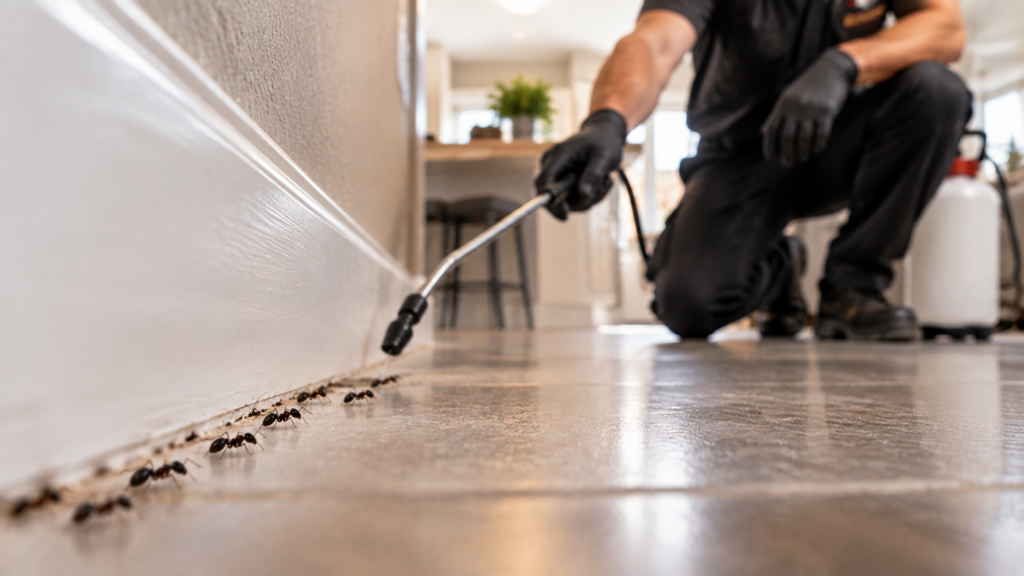
DIY approaches work for low-level pavement ant or odorous house ant activity when entry points can be identified and food sources removed. Carpenter ants, pharaoh ants, and European fire ants consistently require professional assessment. Treating any of these three species without first locating the colony typically extends the infestation.
Ant control in Vaughan and across Ontario is available through Top Choice Pest Control for infestations requiring a professional response.
Frequently Asked Questions
What types of ants are most common in Ontario homes?
The most common ant species in Ontario homes are carpenter ants, pavement ants, pharaoh ants, and odorous house ants. European fire ants are frequently encountered outdoors and can enter structures. Each species differs in size, colour, nesting behaviour, and the type of problem it causes. Correct species identification is the starting point for effective ant control.
Do black carpenter ants cause structural damage?
Yes. Black carpenter ants excavate galleries through decayed or moisture-damaged wood, causing significant structural damage over time. Unlike termites, carpenter ants do not eat wood — they remove it to create nesting space. An established infestation requires professional treatment that locates and addresses both the indoor satellite nest and the outdoor parent colony.
What is the ant life cycle?
An ant colony begins when a fertilised queen lays eggs. Eggs hatch into larvae, which develop through a pupal stage before emerging as adult worker ants. The full cycle from egg to adult takes several weeks and varies by species and temperature. Carpenter ant colonies grow slowly over years; pharaoh ant colonies with multiple queens and satellite colonies can expand rapidly indoors once established.
Are Argentine ants or fire ants found in Ontario?
Argentine ants are not an established pest species in Ontario. Red imported fire ants are not present in Canada. The fire ant species relevant to Ontario homeowners is the European fire ant — reddish-brown, 4 to 5 mm in length, and capable of a painful sting. European fire ants are established across southern Ontario and are commonly found in garden beds and lawn areas.
About Top Choice Pest Control
Top Choice Pest Control serves the Greater Toronto Area and surrounding communities with licensed ant control, wildlife removal, bed bug treatments, and pest management services. The company holds all required Ontario licences, carries commercial liability insurance, and follows Health Canada PMRA guidelines on every service visit.
Service Area
Top Choice Pest Control operates throughout the Greater Toronto Area, including Vaughan, North York, and surrounding southern Ontario municipalities, as well as Barrie, Innisfil, Angus, Orillia, and the broader Simcoe County region.
Next Step
If you have found or identified an ant species in your home and want it assessed and treated, contact Top Choice Pest Control for an inspection. Book through ant control in Vaughan or reach the office directly.
Explore the full range of solutions at Top Choice Pest Control services.