If you have ever swatted at a stinging insect near your Barrie home without knowing whether it was a wasp, a hornet, or a bee, you are not alone — and the difference matters more than you think. These three groups look similar at a glance but differ significantly in body shape, behaviour, diet, nesting habits, venom, and the degree of risk they pose to people, pets, and property. Knowing which insect you are dealing with determines whether you call a pest control professional, contact a beekeeper, or leave the colony alone.
Wasps vs Hornets vs Bees: The Key Differences at a Glance
Bees are fuzzy, round-bodied pollinators built for carrying pollen. Wasps have a narrow pinched waist and smooth bodies, functioning as predators and scavengers. Hornets are a subset of social wasps distinguished by larger size and like other wasps, they can sting multiple times and will defend their nests if threatened. Body shape, colouring, diet, and nest type are the four fastest comparison points.
Bees: Pollinate Flowers
Identifying Bees
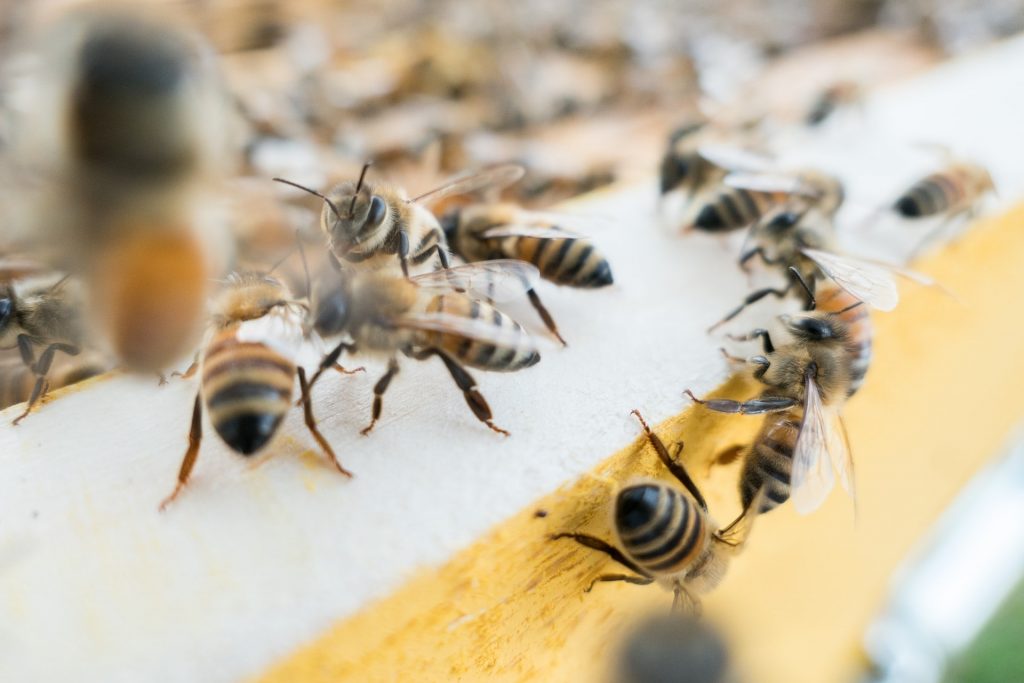
Bees are round-bodied and fuzzy, with flattened hind legs adapted for carrying pollen. Colouring ranges from the familiar yellow and black of honey bees to the metallic blue-green of native solitary bees. Branched body hairs trap pollen as bees move between flowers — giving them a distinctly fluffy appearance compared to the sleek wasp body. Bees play a vital role in pollinating plants, supporting ecosystems, and agriculture alike. Bees themselves prefer to eat nectar from flowers and other vegetable matter. They are less likely to be attracted to human food around picnics or other gatherings.
Male and female bees can be told apart by the number of segments on their antennae and abdomens. Wasps, by contrast, have smooth bodies with minimal hair.
Honey Bees
Honey bees form large perennial colonies of 20,000 to 80,000 worker bees that persist year-round — unlike wasp and hornet colonies, which die off each winter. A queen lays fertilised eggs while worker bees (all female) collect pollen and nectar. Honey bee hives are built from beeswax inside hollow trees, wall cavities, or managed hives. Honey bees are among the most ecologically important beneficial insects on earth and are legally protected from indiscriminate extermination in many jurisdictions.
Carpenter Bees
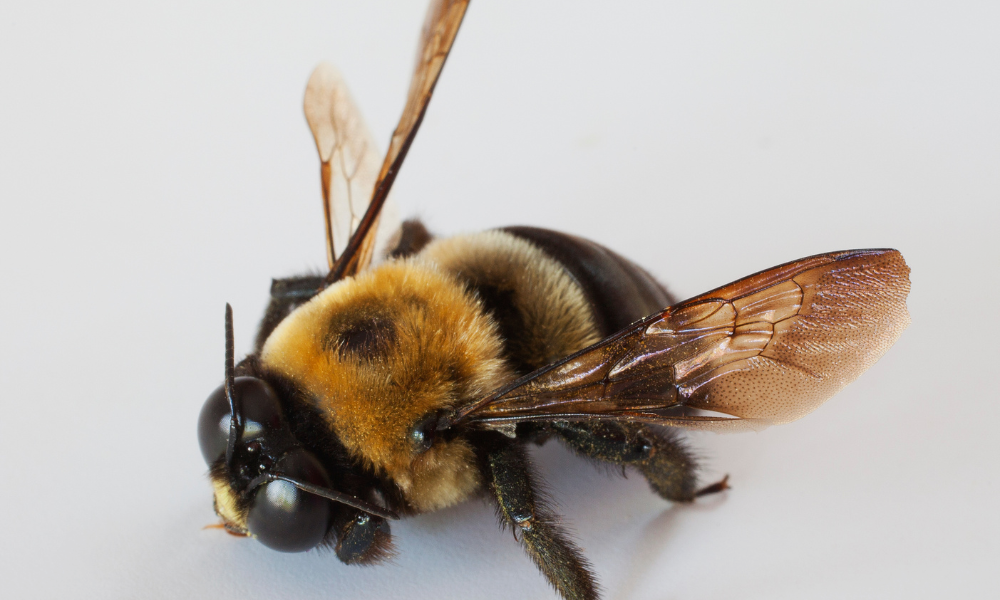
Carpenter bees are large, mostly black solitary bees that bore circular entry holes into bare or weathered wood to create nesting tunnels. Each female builds and provisions her own nest — no colony structure. They are effective pollinators and rarely sting, though males hover aggressively near nesting sites. Repeated carpenter bee activity over multiple seasons causes cumulative structural wood damage and is when pest control becomes appropriate.
Solitary Bees — The Majority of Bee Species
Most of the world’s 20,000+ bee species are solitary — mining bees, leafcutter bees, mason bees, and hundreds of native Ontario species that nest in ground tunnels, plant stems, or small cavities. They are non-aggressive, rarely sting, and are the most effective pollinators of many native Ontario plants. Solitary bees have no communal nest to defend, making them essentially harmless to people.
Do Bees Sting?
Honey bees have a barbed stinger. When a honey bee stings a person, the barb anchors in skin, pulling the venom sac free — the bee dies shortly after. This means honey bees typically sting only once and only when they feel threatened. Bumblebees, solitary bees and all other species can sting repeatedly but rarely do. Honey bee stings can trigger severe allergic reactions (anaphylaxis) in sensitive individuals — anyone who experiences throat swelling, difficulty breathing, or rapid pulse after a sting should seek emergency medical care immediately.
Wasps: Predators, Scavengers, and Accidental Pollinators
Identifying Wasps
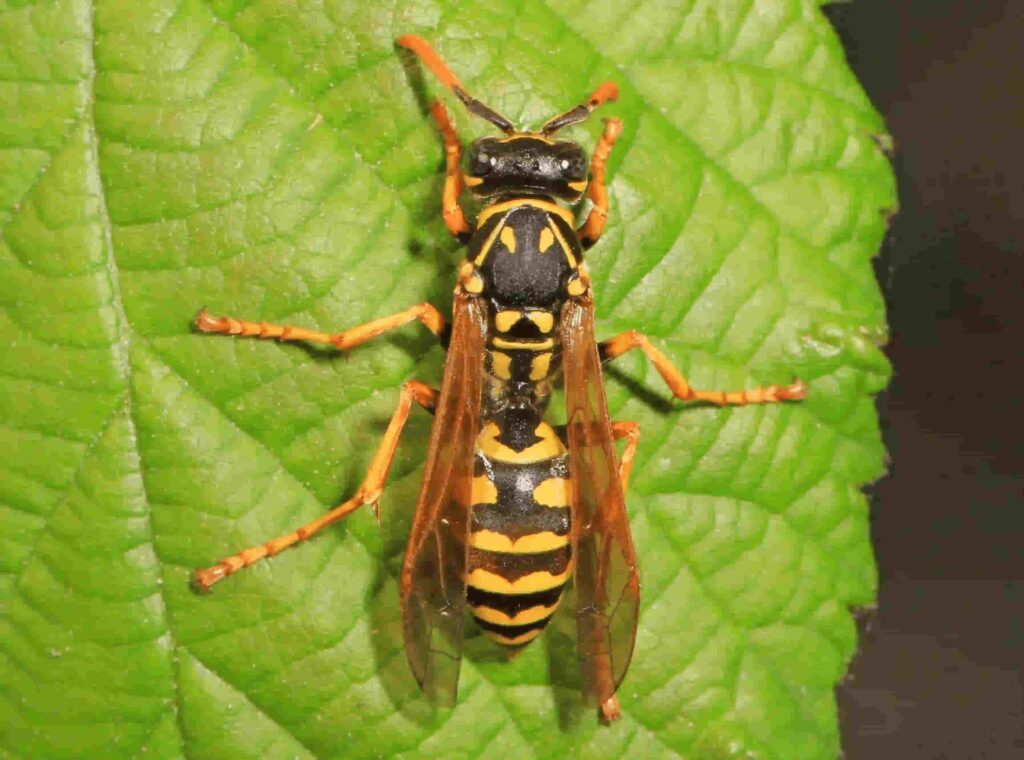
Wasps generally have a narrow, pinched waist (the petiole), smooth bodies with minimal hair, and vivid yellow and black stripes on most social species. They lack the pollen-carrying apparatus of bees and have smooth stingers that allow them to sting multiple times without dying. Wasps dangle their legs in flight — a useful distinguishing feature from bees in motion. Since wasps prey on some bad bugs, they should are considered beneficial to gardeners.
Yellow Jackets — Barrie’s Most Commonly Encountered Wasp
Yellow jackets are the most frequently encountered social wasps in Barrie and across Ontario. Aggressive and capable of stinging repeatedly, yellow jacket colonies number several thousand workers at peak in late summer. They nest underground in abandoned rodent burrows or inside wall cavities, making nests difficult to locate without professional help. In late summer, yellow jacket colonies peak and workers shift from feeding larvae protein to foraging for sugars — this is when they become most aggressive around garbage, food, and outdoor eating areas.
Paper Wasps
Paper wasps — including the European paper wasp now common across southern Ontario — build open, umbrella-shaped nests from chewed wood fibres mixed with saliva. These aerial nests are typically suspended from eaves, deck railings, tree branches, or window frames. Colonies are smaller than yellow jacket nests, typically 20 to several hundred workers. Paper wasps are semi-aggressive — they are non-confrontational unless the nest is directly threatened — but will sting repeatedly if disturbed. Some paper wasps are an invasive species. Their nests are the papery, open-celled structures most Barrie homeowners find under deck overhangs each summer.
Mud Daubers and Other Solitary Wasps
Mud daubers, potter wasps, and thread-waisted wasps are solitary — each female builds and provisions her own nest independently, with no colony to defend. Mud daubers construct tubular mud nests on walls, ceilings, and under bridges. They paralyse spiders and other prey, place them in nest cells, and lay a single egg on the prey before sealing the cell. Mud daubers are among the most effective natural spider controllers and are generally harmless to people. Parasitic wasps lay eggs inside or on other insects; cuckoo wasps parasitise other solitary bee and wasp nests. None of these solitary species is a pest control concern.
What Do Wasps Eat?
Adult feed on liquid diet of nectar, fruit juices, and honeydew. However, they are predators that collect insects, caterpillars, flies, and other invertebrates to feed their developing larvae back at the nest. This predatory behaviour makes social wasps valuable natural pest controllers — a single yellow jacket colony can remove thousands of caterpillars and flies from a garden over a summer season. Wasps also function as accidental pollinators when visiting flowers for nectar, carrying pollen between plants as they forage.
Hornets: Larger, More Aggressive, and More Painful
What Are True Hornets?
True hornets belong to the genus Vespa and are the largest eusocial wasps. Only one true hornet species — the European hornet (Vespa crabro) — is established in North America, though it is still relatively uncommon in Ontario. The bald-faced hornet, often called a hornet by Barrie residents, is technically a large yellowjacket wasp in the genus Dolichovespula, not a true Vespa hornet. Both species build large enclosed paper nests and defend them aggressively.
Bald-Faced Hornet — Common in Barrie
The bald-faced hornet is the large, black and white stinging insect most Barrie residents encounter. It builds large, enclosed, teardrop-shaped aerial nests from chewed wood fibres — often the size of a basketball or larger — in trees, on buildings, and under overhangs. Bald-faced hornets are among the most aggressive stinging insects in Ontario and will defend their nest over distances of several metres. A colony at peak in late summer can number 400 to 700 workers. Do not approach or disturb a bald-faced hornet nest without professional pest control support.
European Hornet
The European hornet (Vespa crabro) is the only true hornet established in Canada. Larger than yellow jackets and paper wasps — European hornets can reach 35 mm in length — they are brown and yellow rather than the vivid black and yellow of common wasp species. European hornets nest in hollow tree trunks, wall cavities, and attic spaces. Unlike most wasp species, they are active at night as well as during the day. European hornet colonies can reach several hundred workers.
Asian Giant Hornet — Status Update
The Asian giant hornet (Vespa mandarinia), sometimes called the “murder hornet,” was detected in Washington State and British Columbia between 2019 and 2021. They attack honeybee colonies, killing the bees by ripping off their heads, eating the honey, and stealing the larvae to feed to their own young. Following intensive eradication efforts by the Washington State Department of Agriculture and Canadian authorities, it was declared eradicated from North America in 2023. There are no confirmed populations in Ontario. If you encounter an unusually large hornet in Barrie, it is almost certainly a European hornet or a large queen yellow jacket — contact a pest control professional for identification rather than attempting to handle it.
Hornet Stings — Why They Hurt More
Hornet stings are generally more painful than wasp or bee stings, largely due to the higher volume of venom delivered per sting and the venom composition. Hornets, like all wasps, have smooth stingers and can sting multiple times. Anyone stung multiple times, stung near the face or throat, or who has a known insect venom allergy should seek medical attention promptly. People with known venom hypersensitivity should carry an epinephrine auto-injector (EpiPen) and consult their physician about venom immunotherapy.
Comparing Nests: How to Identify What You Have
Nest type is the most reliable identification tool when you cannot safely get close to the insects themselves:
• Honey bee hive — wax comb structure in hollow trees, wall cavities, or managed hives; perennial colony that survives winter
• Carpenter bee — circular entry hole bored into bare wood, approximately 13 mm diameter; no colony
• Paper wasp nest — open, umbrella-shaped papery comb suspended from eaves, railings, or branches; visible cells from below
• Yellow jacket nest — underground in abandoned burrows or inside wall voids; entry is a small hole in soil or a gap in structure; no visible nest externally
• Bald-faced hornet nest — large, enclosed, teardrop or football-shaped aerial nest in trees or on structures; grey paper exterior with no visible cells
• European hornet nest — enclosed paper nest inside hollow trees, wall cavities, or attic spaces; active day and night
• Mud dauber nest — small, tubular clay tubes on walls, ceilings, or under bridges
If you find any enclosed aerial nest larger than a grapefruit, a large underground wasp nest, or a nest inside a wall void on your Barrie property — contact Top Choice Pest Control before approaching. Disturbing an active colony triggers a defensive response from hundreds or thousands of insects simultaneously.
Are Bees, Wasps, and Hornets Beneficial Insects?
All three groups provide meaningful ecological value, and this should influence how you respond when you find a nest on your property.
Bees are the primary pollinators of food crops and wild plants in Canada. Honey bee colonies and native solitary bees pollinate an estimated one-third of the food supply. Their decline is a documented conservation concern. A bee colony nesting away from human activity should be left alone or rehomed by a beekeeper rather than exterminated.
Wasps are effective natural pest controllers, consuming enormous volumes of caterpillars, flies, and pest insects through the summer. They also function as accidental pollinators and contribute to nutrient cycling. A paper wasp nest under a rarely used eave is doing more ecological good than harm.
The practical question for pest control purposes is location and proximity. A honey bee colony or paper wasp nest fifty metres from a doorway is a neighbour. The same nest directly over a front entrance, inside a wall, or underground in a heavily used lawn is a safety risk — particularly for households with young children, people with venom allergies, or commercial premises where a sting incident creates liability.
Common Wasp and Hornet Problems in Barrie Homes
Wasps Nesting Under Eaves and Decks
Paper wasps and yellow jackets are the most common stinging insect pest call Top Choice receives each summer in Barrie. Paper wasp nests under eaves and deck railings start small in spring and reach peak size in August. At peak, even a moderately large paper wasp nest of 100 to 200 workers poses a sting risk to anyone using the space below. Professional removal in June or early July — before the colony reaches full size — is significantly easier and less expensive than waiting until August.
Yellow Jackets Nesting in Lawns
Underground yellow jacket nests in Barrie lawns are a particular hazard for children and anyone maintaining the property. A colony disturbed by a lawnmower, garden fork, or foot can mobilise hundreds of workers in seconds. Unlike bees, yellow jackets will pursue threats aggressively. If you notice yellow jackets repeatedly entering a hole in your lawn or garden, treat the area as a live nest and contact a pest control professional.
Hornets Nesting in Trees or on Buildings
Bald-faced hornet nests in trees near dwellings or attached to building soffits and eaves should always be treated by a professional. These nests are at their largest and most aggressive in late summer, precisely when outdoor activity peaks. Attempting DIY removal of an established hornet nest — particularly at night, which many online sources recommend — is dangerous without proper protective equipment and appropriate insecticide application.
Carpenter Bees Damaging Wood Structures
Carpenter bee damage accumulates slowly but compounds year over year as females return to the same structural timber. Painting or sealing exposed wood is the most effective prevention. For active infestations in fascia, soffits, or deck framing, a pest control professional can treat active tunnels and apply a wood surface product that deters future drilling. This is distinct from wasp control and uses different methods.
When to Call Top Choice Pest Control for Stinging Insects
Top Choice Pest Control has served Barrie and Simcoe County since 2015. Our QualityPro certified technicians remove wasp nests, hornet nests, and address carpenter bee activity safely, using appropriate protective equipment and registered insecticide products. We are an 8× HomeStars Award winner with a 4.9-star rating across 91 verified reviews and a 6-month guarantee on all treatments.
Contact us when:
• A wasp, hornet, or bee colony is within five metres of a doorway, window, or heavily used outdoor area
• You have found an underground yellow jacket nest in a lawn, garden bed, or near a foundation
• A large aerial nest (larger than a grapefruit) has appeared on your home or in a nearby tree
• Insects are entering a wall void, attic, or soffit
• A household member has a known venom allergy
• You are a commercial client — a sting incident on premises creates significant liability
Do not attempt to remove large established nests yourself. Leave the area, keep children and pets inside, and call us.
🐝 Wasp or Hornet Nest on Your Barrie Property? Call Top Choice — 416-904-5351 | Free Estimate | 6-month Guarantee
Frequently Asked Questions — Wasps vs Hornets vs Bees
1. What is the easiest way to tell wasps vs hornets vs bees apart?
Body shape is the fastest identifier. Bees are fuzzy and round-bodied. Wasps have a narrow pinched waist and smooth bodies with yellow and black stripes on most social species. Hornets are larger than common wasps — the bald-faced hornet is black and white, the European hornet is brown and yellow. Nest type confirms identification: open papery combs are paper wasps; underground nests are yellow jackets; large enclosed aerial nests are bald-faced hornets.
2. Are honey bees dangerous and should I remove their nest?
Honey bees are generally non-aggressive and vital pollinators. Before removing a honey bee hive, contact a local beekeeper — live removal and rehoming is often possible and preferable to extermination. Extermination is appropriate only when a hive is inside a wall cavity, inaccessible structure, or poses an immediate risk to a person with a known venom allergy. Dead bees inside a wall also attract wax moths and other pests, so professional extraction is preferred over simply killing the colony.
3. Is a bald-faced hornet the same as a hornet?
No, despite the common name. The bald-faced hornet (Dolichovespula maculata) is technically a large yellowjacket wasp, not a true hornet in the genus Vespa. True hornets are represented in Ontario only by the European hornet (Vespa crabro). In practical terms the distinction is minor — both build large enclosed paper nests, defend aggressively, and require professional removal. The only true hornet any Barrie homeowner is likely to encounter is the European hornet.
4. What should I do if I find a hornet nest on my property?
Do not approach or disturb the nest. Hornets defend their nests aggressively and will pursue threats over considerable distances. Keep children and pets well away from the area. Contact Top Choice Pest Control for professional removal — our QualityPro certified technicians use appropriate protective equipment and registered products to treat the nest safely. DIY removal of a large bald-faced hornet or European hornet nest is genuinely dangerous and not recommended.
5. Do carpenter bees cause structural damage?
Yes, over time. Carpenter bees bore circular tunnels approximately 13 mm in diameter into bare or weathered wood. A single season of activity causes minor surface damage. But carpenter bees return to the same sites year after year, and multiple females using the same structural timber — fascia, soffits, deck joists — can cause significant cumulative damage. Paint or seal exposed wood to prevent access. For active infestations, a pest control professional can treat tunnels and apply deterrent coatings.
6. What are the most common stinging insects in Barrie, Ontario?
The most commonly encountered stinging insects in Barrie are yellow jackets (nesting underground and in wall voids), paper wasps (nesting under eaves and on structures), and bald-faced hornets (large aerial nests in trees and on buildings). Honey bees and bumble bees are common pollinators but rarely present pest control problems unless nesting inside a structure. Carpenter bees appear in late spring in Barrie’s wooden structures. European hornets are present but less common than yellow jackets.
7. Are wasps and bees both beneficial insects?
Yes. Bees are the primary pollinators of food crops and wild plants — essential for food production and native ecosystem health. Wasps are natural predators that consume vast numbers of caterpillars and pest insects, and function as accidental pollinators when foraging for nectar. Both groups are best left alone when nesting away from human activity. Professional pest control is the right response only when a nest creates a genuine safety risk to people on the property.
Protect Your Barrie Property — Contact Top Choice Pest Control
Stinging insects are a seasonal reality for every Barrie homeowner. Most nests pose no risk and are better left alone. When a wasp, hornet, or bee colony is in the wrong place — over a doorway, inside a wall, underground in a play area — Top Choice Pest Control provides safe, professional identification and removal. We have served Barrie and Simcoe County since 2015, with QualityPro certified technicians, a 6-month guarantee, and a 4.9-star rating from 91 verified customers. Call for a free estimate.
📞 Call Top Choice Pest Control | 416-904-5351 | Barrie Wasp & Hornet Removal | Free Estimate
Top Choice Pest Control | Barrie, Ontario | QualityPro certified | 8× HomeStars Best of Award winner | Licensed & Insured