Wasp season in Ontario runs from April through October, with colonies reaching peak size—and peak aggression—in late summer. The safest and least expensive treatment window is early in the season, when nests are small and worker numbers are low. Top Choice Pest Control helps homeowners across Ontario identify wasp species, time treatment correctly, and get rid of wasps before the problem becomes dangerous.
Key Takeaways
- Wasp colonies in Ontario can hold several thousand workers by late summer, making August and September the most hazardous months for any removal attempt.
- Yellowjackets measure 10–12mm; queens reach up to 25mm and emerge in April after overwintering in sheltered locations to begin building nests from scratch.
- Unlike most bees, wasps can sting repeatedly—a wasp injects venom with a smooth stinger and can sting multiple times; honey bees have a hollow barbed stinger and die after one use.
- The wasp life cycle—egg, larva, pupa, adult—completes in as little as three to four weeks, allowing colonies to grow rapidly through the early summer months.
- Health Canada recommends following pesticide label directions carefully when treating active wasp nests, as misuse can pose risks to people, pets, and beneficial insect populations.
The Timeline at a Glance
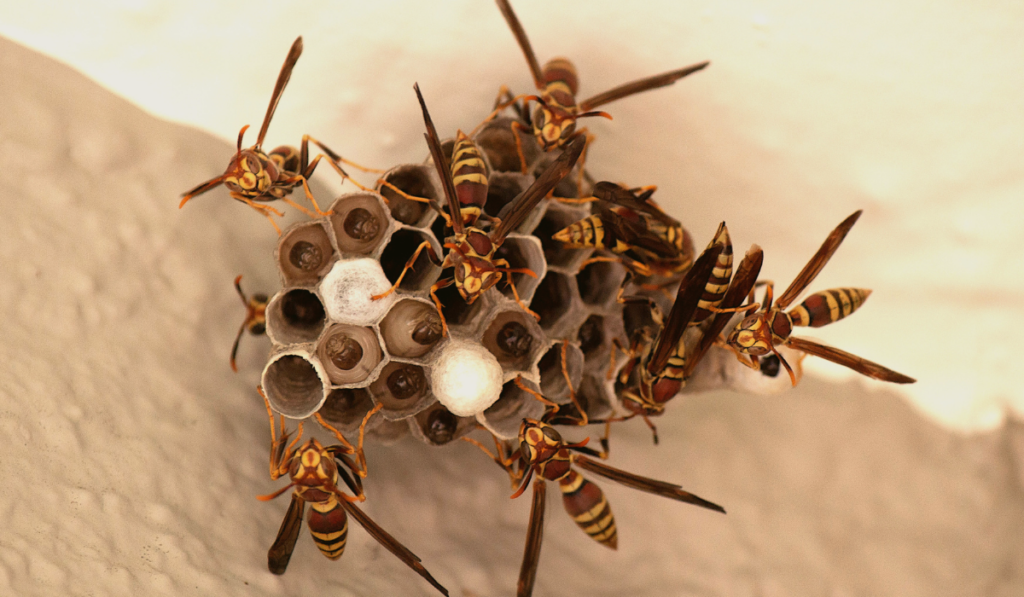
Wasp activity in Ontario follows a predictable seasonal pattern tied directly to the wasp life cycle. The table below outlines what is happening in the colony each month and whether treatment is advisable.
| Month | Colony stage | Nest size | Treat or wait |
|---|---|---|---|
| April | Queen establishing, nest construction begins | Golf ball or smaller | Treat now — straightforward |
| May | First workers emerge | Small, often hidden | Treat — manageable |
| June | Rapid expansion | Fist-sized, some visible | Treat carefully |
| July | Peak growth | Large, well-established | Professional recommended |
| August | Peak population | Maximum size | Professional required |
| September | New queens produced | Declining but aggressive | Professional required |
| October | Colony collapsing | Workers dying | Empty nest safe to remove |
Wasp nests do not reuse between years. A nest left in place over winter is structurally empty by spring and poses no risk. However, fertilized queens overwinter in wall voids, hollow trees, and sheltered roof spaces, and each queen starts fresh nest construction in April.
Working Backwards from the Day
Whether you plan to treat a nest yourself or call a professional, timing the decision correctly relative to the season determines how safe and effective the outcome will be.
Eight Weeks Out
April to early May: Prevent wasps before colonies establish
Fertilized queen wasps emerge from overwintering sites when temperatures rise above 10°C. At this stage, a queen is building a paper nest the size of a walnut to house her first batch of eggs. She is alone. The nest holds no workers yet.
This is the most valuable window in the Ontario wasp season. Inspect eaves, soffits, deck frames, exterior wall voids, and tree branches in April and early May. A nest found at this stage contains fewer than 20 individuals rather than the 3,000 possible by August. Seal gaps around fascia boards and soffits where queens commonly enter to begin building nests. Remove food sources from outdoor eating areas—garbage cans should have tight-fitting lids, and fruit fallen beneath fruit trees should be collected regularly.
Prevent wasps from establishing by reducing potential nesting sites now: remove dead wood, cap hollow fence posts, and check under deck boards. Pest management actions taken in April cost far less in time and money than wasp extermination of a mature late-summer colony, and they prevent future infestations in the same locations.
Four Weeks Out
Late May to June: Identify wasps and assess the infestation
By late May, the first generation of workers has emerged and started expanding the nest. Nests are now fist-sized and visible under eaves, on tree branches, inside wall voids, or in the ground. Ground nesting wasps—primarily yellowjackets in Ontario—are identified by concentrated flying insects activity around a single entrance hole in soil, a foundation crack, or a retaining wall gap. Dead wasps near a building entrance or on window sills can also indicate an active nest close by.
Before deciding on a treatment method, identify the wasp species. Yellowjackets and bald-faced hornets are the most aggressive social wasps in Ontario and defend their nests forcefully when disturbed. A hornet infestation inside a wall void or tree cavity requires professional wasp control, not DIY aerosols. Paper wasps, which have elongated legs and build open-comb paper nests hanging from a stalk, are generally less aggressive and rarely sting unless directly handled. Solitary wasps—which live alone and do not form colonies—pose very little risk and rarely require treatment.
It is also worth confirming whether the flying insects are actually wasps. Honey bees are sometimes confused with yellowjackets. Honey bees are rounder, fuzzier, and golden-brown; they rarely sting and are critical pollinators. If you discover a honey bee colony, contact local beekeepers rather than a pest control company—bees can often be relocated. The bee and wasp distinction matters because treatment methods, urgency, and legal considerations differ. For help distinguishing species before committing to treatment, see DIY vs professional nest removal in Barrie.
What to Confirm in Writing
Before committing to a treatment approach, document:
- Confirmed nest location, approximate size, and attachment point
- Entry and exit points observed across at least two visits at different times of day
- Wasp species identified, or a clear note that identification is uncertain
- Whether any household members have known allergic reactions to wasp venom
- Whether the nest is accessible without a ladder or entry into a confined space
This information helps a professional pest control technician quote accurately and plan wasp pest control treatments before arriving on site.
The Detail Most People Forget
Most homeowners record the visible nest opening but miss secondary entry points—gaps under siding, ventilation gaps in soffits, or cracks beside window frames—that workers use when the primary entrance is disturbed during treatment.
Why It Matters
Secondary entry points left untreated allow surviving workers to resume activity at the same location within days, which typically requires a follow-up call at additional cost and extends exposure to stinging insects.
One Week Out
Early to mid-July: Pre-treatment preparation
If professional wasp nest removal Barrie has been scheduled, the week before the visit is the time to prepare the site. Move vehicles, outdoor furniture, and children’s play equipment away from the treatment zone. Mark any secondary entry points you have observed so the technician can treat every access point in a single visit.
Avoid disturbing the nest in the days before treatment. Vibration from lawn mowers, string trimmers, and other power tools operated near an active nest can trigger defensive swarming before the scheduled treatment date. Keep pets and children indoors when wasp activity is high, particularly in early morning and late afternoon when most wasps are most active around the nest.
On the Day
Treatment day: What to expect
On treatment day, clear the area of people and pets. If treating yourself, wear full protective clothing—long sleeves, sealed gloves, and closed footwear—and avoid walking barefoot near any ground nesting wasp site. Wasp pest control treatments work best when applied at dusk or dawn, when the majority of workers are inside the nest and movement is minimal.
Apply any pesticide product in strict accordance with Health Canada label directions. A wasp injects venom with a smooth stinger and can sting repeatedly if not neutralized quickly; painful stings can cause swelling, and multiple stings in sensitive individuals may require medical attention. Never attempt to seal an active entrance hole immediately after treatment—workers returning to a sealed entrance become disoriented and highly aggressive. Leave the nest undisturbed for a minimum of 48 hours after treatment to allow the product to reach the entire colony. The guide on wasp nest removal safely covers protective gear, timing, and registered product options in detail.
Sizing It Correctly
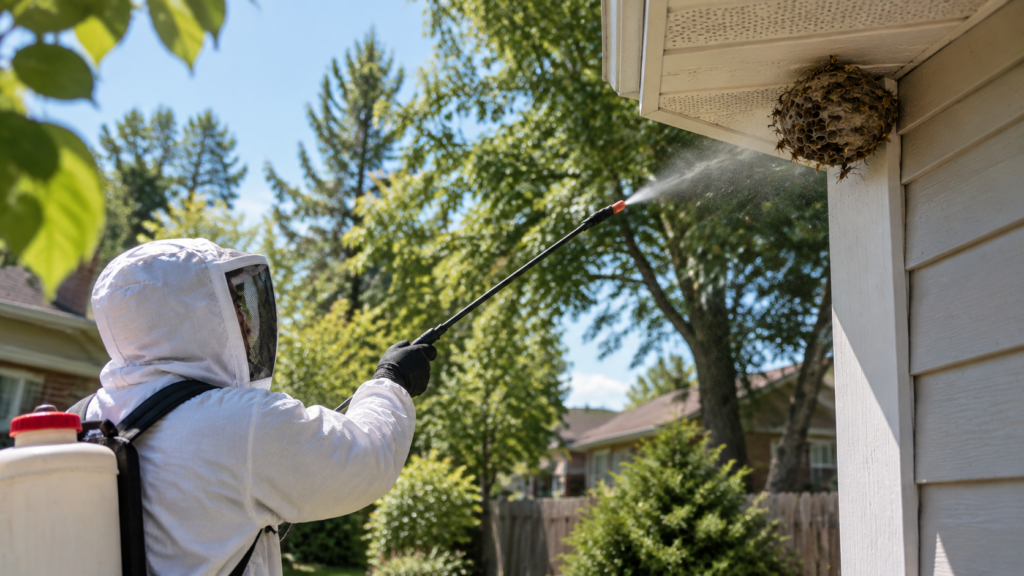
The size of a wasp infestation at the time of treatment determines both risk level and the likelihood of a successful single application. A young spring nest with fewer than 100 workers is manageable for a careful homeowner with appropriate protective equipment and a registered aerosol product. A mid-summer nest of several hundred social wasps requires a residual pesticide that can reach the interior of the colony structure. A late-summer nest exceeding 1,000 workers—or any yellowjacket or hornet nest inside a wall void or attic—is a task for professional wasp control.
Use these indicators to estimate colony size before deciding on an approach:
| Indicator | What it suggests |
|---|---|
| Nest under 10cm, few guards visible | Small colony, likely spring — treat yourself or call early |
| Nest 10–20cm, enclosed paper exterior, steady traffic | Medium colony — consider professional assessment |
| Nest over 20cm, continuous activity, aggressive response | Large colony — professional wasp nest removal required |
| Flying insects entering wall, soffit, or ground hole | Interior or ground nest — professional required regardless of size |
Any nest inside a wall, ceiling void, or roof space warrants professional treatment. Access to the interior and knowledge of where the colony has expanded through the nest construction phase are both required for safe, complete elimination.
Budget
Wasp nest removal costs in Ontario vary by species, nest size, location, and ease of access. The ranges below reflect general market pricing and are provided as a guide only—confirm current pricing with your pest control provider before booking.
| Removal type | Estimated range (CAD) |
|---|---|
| Exposed exterior nest, small | $150–$250 |
| Exposed exterior nest, large | $250–$400 |
| Ground nest | $200–$350 |
| Wall void or interior nest | $350–$600+ |
| Multiple nests, same property | Priced per nest, often discounted |
DIY aerosol products cost $15–$30 per can and may require multiple applications for an established wasp infestation. Factor in the cost of protective clothing, preparation time, and the possibility of a repeat treatment if the colony is not fully eliminated on the first attempt. For GTA-area pricing and service details, wasp nest removal Vaughan covers service options for clients outside Barrie.
What Goes Wrong, and How to Avoid It
Treating too late in the season. The majority of professional calls come in during August, when colonies are at their annual maximum. A wasp infestation that could have been treated in May—or avoided entirely through spring exclusion—now requires professional wasp extermination and carries real physical risk. Early detection in April or May is consistently the most cost-effective approach and the most reliable way to prevent future infestations.
Disturbing a ground nest on foot. Yellowjackets respond to vibration before they respond to sight or smell. Accidentally mowing over or stepping near an active ground entrance is one of the most common sources of painful stings in Ontario. Concentrated flying insects activity near a low point in a lawn, a foundation gap, or a retaining wall edge warrants a careful inspection before any work in that area.
Sealing an active entrance without treating the colony. Blocking the entrance of an active nest forces workers to locate alternative exits—frequently through interior wall spaces into living areas. This turns an outdoor pest issue into an indoor one. Never seal entry points while wasps are actively entering or exiting. Wait a minimum of 48 hours after a confirmed treatment before sealing any opening.
How Top Choice Pest Control Runs It in Barrie
Top Choice Pest Control follows a structured process for professional wasp control in Barrie: confirm the species and nest location, identify all access points including secondary gaps, apply Health Canada–registered wasp pest control treatments to the colony, and verify elimination before closing the visit. Technicians carry full protective clothing and use products compliant with the Pest Management Regulatory Agency. For nests inside wall voids or structural cavities, Top Choice locates secondary entry points frequently missed in DIY attempts, reducing the likelihood of a return wasp infestation in the same location. The company’s wasp nest removal service covers Barrie and surrounding Simcoe County, with same-season follow-up available when residual activity is observed after the initial treatment.
Frequently Asked Questions
What is the life cycle of a wasp colony in Ontario?
A wasp colony begins in April when a fertilized queen emerges from overwintering and starts building a paper nest. Eggs hatch into larvae, then pupae, then adult workers. Worker numbers grow through June and July, peaking in August. New queens and males are produced in late summer. Workers die before winter; only fertilized queens survive to start new colonies in spring.
What attracts wasps to a property?
Wasps are drawn to sweet foods, fruit juices, decaying fruit near fruit trees, and protein-based food waste in uncovered garbage cans. Outdoor eating areas with accessible food attract foraging workers. Wasps also look for sheltered locations for nest construction: wall voids, hollow trees, under deck frames, and in attic spaces. Removing food access and sealing potential nesting sites in spring limits establishment.
How can I prevent wasps from building nests on my property?
Inspect eaves, soffits, deck frames, and wall voids in April before queens establish new colonies. Seal gaps with caulk or mesh. Remove dead wood and cap hollow fence posts. Keep garbage cans tightly covered and clean outdoor eating areas after use. Prevent wasps early in the season rather than treating an established nest—a colony found in April is far easier to address than one found in August.
When should I call a professional wasp control service?
Call a professional wasp control service when the nest is inside a structure, when the colony is larger than a fist, when a bee and wasp identification is uncertain, or when any household member has a history of allergic reactions. Professional wasp nest removal is also advisable for ground nests, hornet infestations, and any situation where access requires a ladder or entry into a confined space.
About Top Choice Pest Control
Top Choice Pest Control serves Barrie and surrounding communities with licensed, fully insured pest management services. The company holds all required Ontario licences and uses only Health Canada–registered products applied by trained technicians. Services cover bee and wasp control, ants, bed bugs, cockroaches, rodents, spiders, and wildlife removal. Review the full range of wasp nest removal options on the company website for service and coverage details.
Service Area
Top Choice Pest Control operates throughout Barrie, Innisfil, Angus, Orillia, and the broader Simcoe County region. Service also extends across the Greater Toronto Area, including Vaughan, North York, and surrounding southern Ontario municipalities. Contact the Barrie office directly for scheduling or a same-season assessment.
Next Step
If you have found an active wasp nest on your Barrie property and want it assessed and removed safely, contact Top Choice Pest Control. Book through the wasp nest removal page.
Explore the full range of solutions at Top Choice Pest Control services.