Carpenter ants leave coarse frass and smooth galleries; termites leave mud tubes and rough, soil-packed galleries. In Ontario, carpenter ant infestations are far more common than termite activity, but the structural risk from a missed termite infestation is significant. Top Choice Pest Control helps Barrie homeowners confirm which pest is present so the correct treatment is applied from the first visit.
Key Takeaways
- Carpenter ants do not eat wood — they excavate it, leaving smooth, clean tunnels and coarse frass containing wood shavings and insect parts.
- Subterranean termites build mud tubes to travel from soil to structural wood; a mud tube on a foundation wall is a definitive termite sign.
- Carpenter ants measure 6–13mm and have a narrow waist and elbowed antennae; termites are smaller, pale, and have a broad waist with straight beaded antennae.
- Winged carpenter ants have unequal front and hind wings; termite swarmers have equal-length wings — this is the fastest way to tell flying ants from termite swarmers.
- Discarded wings near a door frame in early spring could indicate either species; wing size confirms which one you are dealing with.
The Short Answer
Coarse frass near a baseboard or window sill indicates carpenter ants; mud tubes on a foundation wall or rough-layered galleries inside structural wood indicate subterranean termites. These two pests behave differently, damage wood differently, and require different treatments. Top Choice Pest Control provides carpenter ant control in Barrie and across southern Ontario for confirmed carpenter ant infestations.
Side-by-Side Comparison
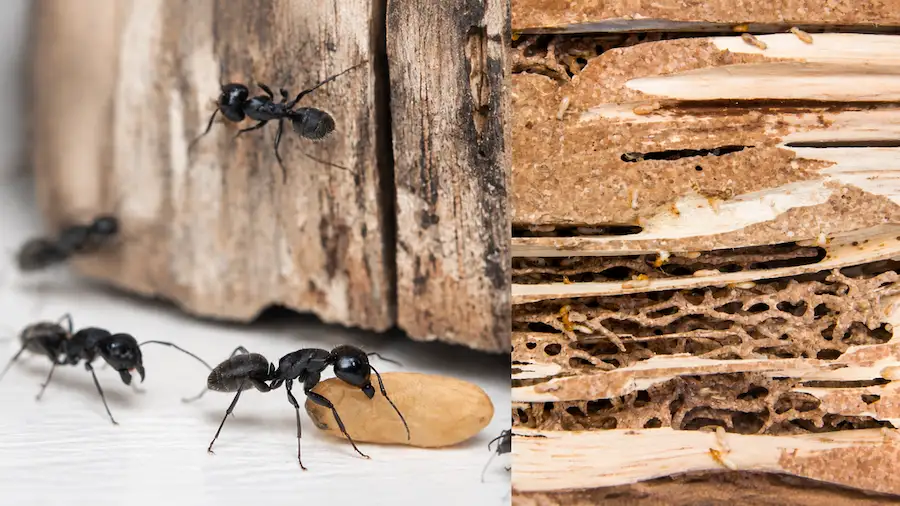
The table below compares the physical signs left by carpenter ant damage and termite damage as they appear during a home inspection.
Comparison Table
| Sign | Carpenter ant infestation | Termite infestation |
|---|---|---|
| Frass or droppings | Coarse sawdust-like frass; wood shavings, insect parts, sand-like particles | Subterranean termites leave no visible frass; drywood termites leave hexagonal pellets (not established in Ontario) |
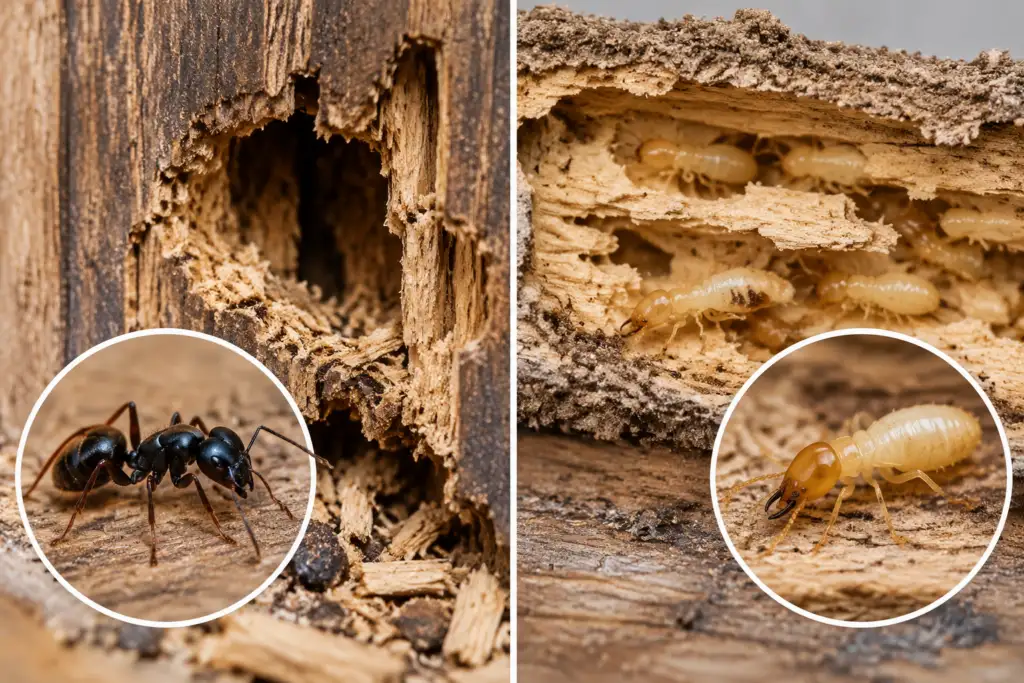
| Galleries inside wood | Smooth, clean tunnels running along the wood grain | Rough, layered galleries across the grain; soil and mud packed inside |
| External signs | Little piles of frass near tunnel openings; frass on window sills or floors | Mud tubes on foundation walls, crawl spaces, or sill plates |
| Wings | Front wings larger than hind wings — wings are unequal | All the same size — termite wings are equal in length |
| Body shape | Narrow waist, elbowed bent antennae, black or reddish | Broad waist, straight antennae, creamy tan or white |
| Wood preference | Moist, decaying wood near damp areas or plumbing leaks | Both healthy and rotting wood; termites eat wood for cellulose |
| Visibility | Often seen foraging at night; rustling sounds in wall voids | Rarely seen; remain hidden in wood or soil |
Cost
Professional ant control Barrie for a carpenter ant infestation typically costs $150–$350, depending on colony size and the number of satellite nests. Termite control costs more — subterranean termite treatment in Ontario ranges from $500–$2,500 or more, depending on the extent of infestation and whether a liquid barrier, bait system, or combination is used.
Option A: Carpenter Ant Treatment
Professional carpenter ant treatment targets both the indoor satellite colony and the outdoor parent colony. Residual product is applied to galleries, entry points, and foraging trails inside the structure. For a full overview of what this process involves, see what does ant pest control do. Follow-up confirms elimination — typically within two to four weeks.
The Caveat Most People Miss
Eliminating carpenter ants without correcting the moisture source — a plumbing leak, wet sill plate, or roof penetration — results in re-infestation within one to two seasons as new ants locate the same damp wood.
Option B: Termite Treatment
Subterranean termite treatment involves either a liquid soil barrier around the foundation or an in-ground bait station system. Bait systems require multiple visits over a full season to confirm colony suppression. Structural lumber that has sustained significant damage often requires repair or replacement after elimination is confirmed.
Time and Effort
A carpenter ant infestation caught early resolves in two to four weeks with professional treatment and moisture correction. A subterranean termite infestation takes a full season to confirm elimination via bait, plus additional time for any structural repairs. Early intervention on both pests reduces both the treatment timeline and the repair cost.
Outcome and Risk
Carpenter ant damage progresses through moist, compromised wood rather than sound wood and is generally slower than termite damage. Termite infestations can cause severe hidden structural damage to sound structural lumber over months or years with no visible external signs until significant damage is already done. Both require a professional inspection before any treatment decision.
When Carpenter Ant Treatment Is the Right Call
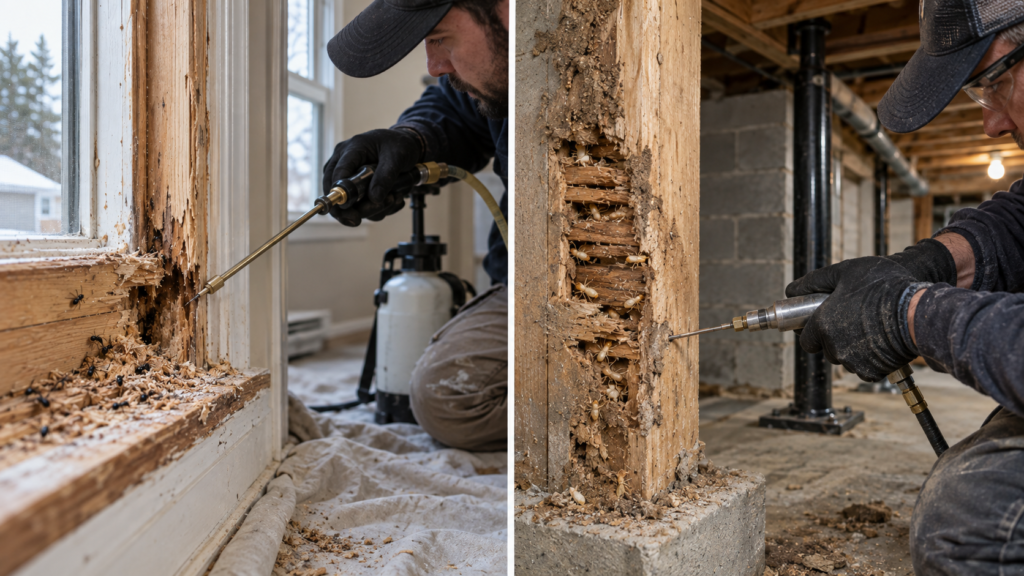
Coarse frass appears near baseboards or window sills. Carpenter ant frass is the most reliable indicator — coarse, irregular, and containing wood shavings and dead insects. It accumulates in small piles near tunnel openings. For a visual reference, what do carpenter ants look like covers size, colour, and body features in detail.
Hollow-sounding wood is found near plumbing or exterior walls. Carpenter ants prefer moist, decaying wood. Tapping along a floor joist or wall stud and finding hollow sounding wood in an area with a known moisture history points to an active carpenter ant infestation rather than termites.
Large winged ants appear indoors in spring. Flying carpenter ants emerging indoors — particularly near window frames in late April or May — indicate an established indoor nest that has produced reproductive ants. Unequal wings confirm carpenter ants rather than termite swarmers.
When Termite Treatment Is the Right Call
Mud tubes appear on foundation walls or in crawl spaces. Subterranean termites construct mud tubes — narrow tunnels of soil, wood debris, and saliva — to travel from the ground to structural wood above the foundation. A mud tube in a crawl space or on a sill plate is a definitive termite sign that warrants immediate professional assessment.
Wood shows rough, layered galleries packed with soil. Unlike the smooth clean tunnels carpenter ants produce, termite galleries run across the wood grain and contain packed soil and debris. Opening a suspect piece of damaged wood and finding this pattern confirms termites and rules out carpenter ants.
Equal-length discarded wings appear near a door or window. Termite swarmers shed wings after swarming. A pile of equal-length wings near a door frame in spring — with no live insects present — suggests a termite colony nearby. Carpenter ant wings are unequal in length; if the front wings are clearly larger, they are flying ants, not termite swarmers.
What Most People Get Wrong
The most common error with a carpenter ant infestation is spraying the frass pile or the wall surface near it. Carpenter ant frass is unwanted debris left at tunnel exits, not the colony itself. Surface sprays do not reach the satellite nest inside the wall void or the parent colony outdoors. Residual product must be applied at foraging trails and nest entry points to be effective — not at the visible sawdust.
A second consistent mistake is assuming ants and termites require the same response because both are found in wood. These two pests behave differently, tunnel differently, and leave entirely different signs. The same misidentification cost applies to any pest pair — as the guide on Rats vs mice how to tell which one have illustrates, species confirmation before treatment is always the first and most important step.
What We Recommend for Barrie Homeowners
Top Choice Pest Control recommends a professional inspection to confirm species before any product is applied. Carpenter ants and termites require different approaches, and the cost of treating for the wrong pest is both the wasted treatment and the continued damage from the untreated one.
For confirmed carpenter ant activity in Barrie, technicians locate the satellite nest, identify the moisture source, and apply targeted treatment at all active points. For suspected termite activity, a thorough inspection of the foundation, crawl spaces, sill plates, and structural lumber is completed before any recommendation is made. Book carpenter ant control through Top Choice Pest Control for a Barrie-area inspection.
Frequently Asked Questions
What is the difference between carpenter ants vs termites?
Carpenter ants have a narrow waist, elbowed antennae, and do not eat wood — they tunnel through it. Termites have a broad waist, straight beaded antennae, and eat wood for cellulose. Body shape, wing size, and the signs left behind — frass versus mud tubes — are the three fastest ways to tell carpenter ants vs termites apart without a professional inspection.
What does carpenter ant frass look like?
Carpenter ant frass is coarse and irregular, resembling sawdust mixed with sand and insect parts. It accumulates in small piles near tunnel openings — often on window sills, floors, or along baseboards below wall penetrations. It is not uniform in texture, which distinguishes it from the tightly packed hexagonal pellets drywood termites leave (not found in Ontario).
How do I know if I have a carpenter ant infestation or termites?
Check for three things: frass type, gallery texture, and external structures. Carpenter ant damage produces coarse frass and smooth galleries in moist wood. Termite damage produces rough, soil-filled galleries and mud tubes on foundation surfaces. Flying ants indoors in spring with unequal wings indicate an established carpenter ant nest; equal-length discarded wings point to termites.
Can ants and termites both be in the same structure at the same time?
Yes, though it is uncommon. Carpenter ants are known to prey on termites and occasionally establish satellite nests near termite activity. When both ants and termites are present, they require separate treatment programmes — a product effective on one pest typically does nothing for the other. A single professional inspection can identify both and sequence the treatment correctly.
About Top Choice Pest Control
Top Choice Pest Control serves Barrie and surrounding communities with licensed pest management covering carpenter ants, termites, bed bugs, cockroaches, rodents, wasps, and wildlife. The company holds all required Ontario pest control licences, carries liability insurance, and follows Health Canada PMRA guidelines on every service call. For GTA clients, professional carpenter ant control is available across Vaughan, North York, and surrounding municipalities.
Service Area
Top Choice Pest Control operates throughout Barrie, Innisfil, Angus, Orillia, and the broader Simcoe County region. The company also serves clients across the Greater Toronto Area, including Vaughan, North York, and surrounding southern Ontario municipalities.
Next Step
If you have found frass, mud tubes, hollow-sounding wood, or winged insects in your Barrie home, contact Top Choice Pest Control for a confirmed inspection. Book through carpenter ant control.
Explore the full range of solutions at Top Choice Pest Control services.